Do People Actually Look at You in the Gym? An Honest Answer
Quick Answer: Yes, briefly, and far less than you think. People do glance — humans track movement and faces automatically. But the spotlight effect is one of the most replicated findings in social psychology: we substantially overestimate how much others notice and remember us. The glance is real; the sustained attention and the judgement you are imagining are mostly not.
Most articles on this answer with a flat no, nobody is looking at you.
That is not quite true, and saying it makes it easy to dismiss the whole reassurance.
So here is the more useful version, structured as the questions people actually have.

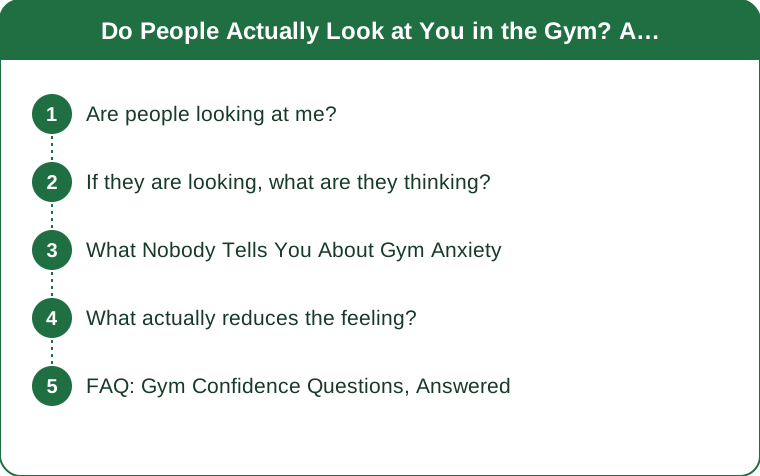
Are people looking at me?
Sometimes, for about a second, and then they are not.
Human visual attention is drawn automatically to movement, faces and novelty. Someone walking into a room, someone setting up at a rack, someone doing an unusual exercise — all of that captures a glance. That is reflex, not evaluation.
What does not happen the way you imagine is the part after the glance. The spotlight effect — first characterised experimentally in the late 1990s — describes a robust and repeatable finding: people consistently and substantially overestimate how much observers notice their appearance, mistakes and behaviour. In the original studies, participants wearing something they felt conspicuous about roughly doubled their estimate of how many people would remember it.
There is a second, related finding worth knowing: the illusion of transparency, where we overestimate how visible our internal states are to others. You feel intensely self-conscious, and you assume that feeling is legible on your face. It is much less legible than it feels.
The practical translation: the glance is real, so stop trying to disprove it. The story you attach to the glance is the part that is wrong.
If they are looking, what are they thinking?
Overwhelmingly: nothing about you.
Surveys of gym-goers on this topic consistently produce the same shape of answer — most people report being preoccupied with their own workout, their own form, their own next set, and their own self-consciousness. Gym anxiety is common rather than rare, which means a substantial share of the people you are worried about are worried about you worrying about them.
When people are thinking something, the honest breakdown is mundane. How many sets you have left on the equipment they want. Whether that is a machine they should try. Occasionally, mild admiration, which people rarely consider as a possibility.
There is a specific thing worth naming: experienced lifters are the least likely to be judging you. They remember being new, they know how form develops, and they are usually the ones who offer to help. The judgement people fear tends to be imagined in the voice of a stranger who does not exist.
Nothing about this makes the feeling less real. Anxiety does not respond to being told it is statistically unjustified. But it does respond to specific, repeated experience of the feared thing not happening, which is the point of the next question.

What Nobody Tells You About Gym Anxiety
It gets worse before it gets better, in a specific way. Weeks two to four are often harder than week one, because the novelty adrenaline has worn off and you are still not familiar. People quit in that window and conclude they are not gym people.
Familiarity does more than confidence does. The variable that predicts comfort is not self-esteem — it is how well you know the room. Same time, same days, same corner, for three weeks. Knowing where things are removes most of what felt like anxiety.
Having a written plan removes the visible hesitation. Standing in the middle of the floor deciding what to do next is the single most exposing thing you can do, and it is entirely avoidable with a piece of paper.
Autumn is the good time to arrive, not the bad one. Everyone assumes January. In reality, September brings a wave of new members, so the room is full of other people who also do not know where the cable attachments live.
Nobody remembers the thing you are still thinking about. The dropped weight, the wrong machine, the wobble. There is no evidence any of it persists in another person’s memory past the same day, and the spotlight-effect research suggests strongly that it does not.
Headphones are a legitimate tool, not avoidance. They narrow attention, and narrowed attention is most of what you want.
What actually reduces the feeling?
In order of demonstrated effect.
Go at the same time on the same days. Repetition builds familiarity with the room, the staff and the regulars. Comfort follows familiarity, not the reverse.
Arrive with the session written down. Exercise, sets, reps, weight. No deciding on the floor.
Start in the part of the gym you find least intimidating, even if it is not optimal training. A month of comfortable-but-imperfect training beats three sessions of ideal programming followed by never returning.
Learn two or three machines properly before broadening. Competence in a narrow area transfers as general confidence surprisingly well.
Use quieter hours to learn new things, and busy hours for things you already know. Learning a movement for the first time when the floor is full stacks two hard things.
Name the feeling instead of arguing with it. There is decent evidence that labelling anxiety reduces its intensity more effectively than trying to suppress or reason it away. Nervous, and going anyway, is the whole skill.
If gym anxiety is part of a broader anxiety pattern that limits daily life, that is worth talking to a professional about — it is highly treatable. This is general information, not medical advice.
FAQ: Gym Confidence Questions, Answered
Is it better to bring a friend?
For the first two or three sessions, yes — it lowers the barrier to walking in. Beyond that it can slow things down, because you never build your own familiarity with the room. Bring someone at the start, then go alone by week two.
What if I use a machine wrong and someone sees?
It happens to everyone, it is forgotten within the hour, and it is the fastest way to learn. If you want to reduce the odds, watch a short video of the movement before you leave the house. Staff will also show you, and being asked is the most interesting thing to happen to them that shift.
When does it stop feeling like this?
Most people report a clear shift somewhere between six and twelve sessions, which is why the same-time-same-days approach matters more than any mindset technique. Twelve sessions is four weeks at three a week.
TL;DR:
- People glance because humans track movement — but the spotlight effect means you vastly overestimate the attention that follows.
- Most gym-goers are absorbed in their own workout, and many share the same anxiety.
- Familiarity, not confidence, is the variable that changes things — same time, same days, three weeks.
- Arrive with the session written down; floor-level deciding is the most exposing thing you can do.
- Expect a real shift at six to twelve sessions, and weeks two to four to be the hardest.
Pick three fixed slots next week, write the session out before you leave, and go to the same corner each time. The plan is deliberately boring, and boring is what actually resolves this.
See It in Motion
Seen here: UPF 50+ Racerback Yoga Tank Top — shop it on bubblelime.com
Keep Reading
This article is for general informational and styling purposes only. Fit, sizing, and product availability may vary.