How Do You Know If Youre in Someones Way in a Group Class?
Quick Answer: The working rule is that you need enough space to extend your arms and one leg in every direction without contacting anyone, which in most classes means roughly six feet between mat centres. You are in someone’s way if they have to alter their movement because of your position, and the reliable signal is someone repeatedly adjusting, shortening a movement, or glancing at your space. Arriving five minutes early and setting up in a spot with clear sightlines to the instructor solves nearly all of it.
The conventions are real and unwritten, which is why they feel like something everyone else was told.

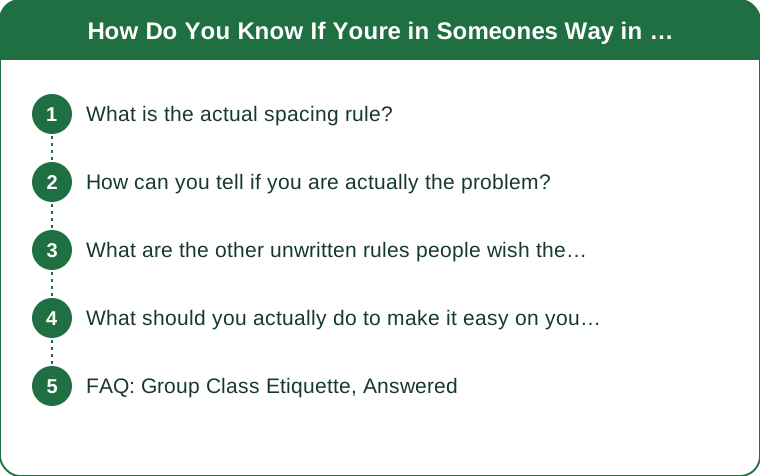
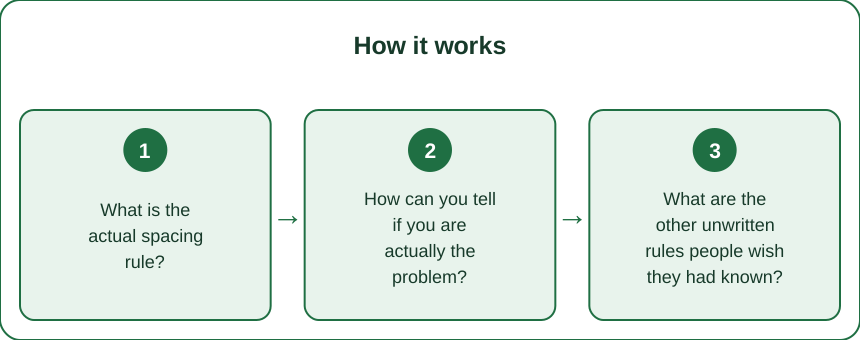
What is the actual spacing rule?
The functional test is arm span plus a leg extension in every direction. Stand on your spot, extend both arms out, and imagine adding a leg in each direction. If that envelope overlaps someone else’s, you are too close for a class involving any dynamic movement.
In practice that translates to roughly six feet between the centres of mats in a mat-based class, and more in classes with travelling movement. Studios often mark the floor, and where they do, the marks are the answer and you should use them.
What if the class is full and there is not enough space?
Then everyone compresses equally, which is normal and fine. The etiquette failure is taking more than your share when space is tight, not being close to people when the room is full.
Do I need to leave space in front of and behind me too?
Yes, and people forget this. Many exercises travel forward, and a plank walkout or a burpee occupies significantly more length than the mat. Front-to-back crowding causes more collisions than side-to-side.
Should I move if someone sets up too close to me?
Moving your own mat six inches is a normal, silent, entirely acceptable adjustment and nobody will think anything of it. Doing it without comment is the convention.
How can you tell if you are actually the problem?
There are reliable signals and they are easier to read once you know to look for them.
Someone shortening a movement is the clearest one. If the person next to you is doing a half-range arm movement while everyone else is doing a full one, they are avoiding you. Same for someone stepping back rather than forward on a lunge.
Repeated small adjustments to their mat or their position, especially in the first few minutes, means they are trying to solve a spacing problem without saying anything.
A glance at the floor between you is usually someone assessing the gap.
Will anyone just tell me?
Usually not directly, which is the frustrating part. Most people will silently adjust rather than speak, particularly in a class setting. Instructors will sometimes say something, and good ones do.
What if I only notice halfway through?
Move between exercises, at a natural break, without making it a moment. Sliding a mat over during a transition is invisible.
Is it rude to ask?
No, and a quiet do you have enough room at the start is completely normal and generally appreciated. It is much easier to ask before class than to work it out during.

What are the other unwritten rules people wish they had known?
Spacing is the main one and there are several others that cause the same quiet anxiety.
Where should a beginner stand?
Not the front row, and not hidden in the back corner either. The second or third row toward the middle gives you sightlines to the instructor and to experienced participants you can follow, which is genuinely useful. The back corner has the worst view and is where you are most likely to lose the sequence.
Is it rude to leave early?
No, if you do it quietly and ideally tell the instructor beforehand. Leaving during the cool-down without a word is the version people notice. Skipping the cool-down entirely is common and generally accepted.
Do I have to do every exercise?
No. Taking a modification, resting, or holding a base movement is completely normal and every good instructor expects it. The people who look like they never rest have usually been coming for years.
What about equipment?
Take what the instructor asks for, put it back where it came from, and wipe it. If you are unsure how much weight to take, take less; walking to change it mid-class is easy and normal.
Should I talk to the person next to me?
Before class, briefly, is fine. During, generally not. Reading the room matters here more than a rule.
What about arriving late?
Many studios have a cut-off and it is worth checking. If you are let in late, set up at the back, quietly, and warm yourself up rather than jumping straight into the current exercise.
What should you actually do to make it easy on yourself?
Arrive five minutes early. This is the whole answer to most of it. Early arrival gives you a choice of position, time to set up properly, and a moment to tell the instructor it is your first time. Late arrival forces you into whatever gap is left, which is usually the worst spot in the room.
Tell the instructor you are new. A single sentence before class. Good instructors will keep an eye on you, offer modifications, and correct you kindly rather than publicly. It also means nothing that happens afterward is a surprise to them.
Set up with a clear line to the instructor. Not necessarily close, but with an unobstructed view. Being unable to see the demonstration is the most common cause of falling behind, and falling behind is what actually makes people feel exposed.
Watch one round before joining a complicated sequence. Standing and watching for eight seconds is invisible and saves you from doing something wrong for a full minute.
Assume nobody is watching you, because they are not. People in classes are watching the instructor and monitoring their own discomfort. The self-consciousness is real and the audience is imaginary.
And go back to the same class. Almost all of this dissolves on the third visit, because you know the room, the format and the instructor, and the spacing conventions of that particular studio have become obvious rather than mysterious.
FAQ: Group Class Etiquette, Answered
What if I accidentally hit someone?
Say sorry briefly, both of you move on, and it is genuinely not a big deal. It happens in every busy class.
Is it acceptable to save a spot for a friend?
Generally frowned upon in a busy class, and normal in a quiet one. If the studio has a booking system for spots, use that.
Should I clean my mat if I brought my own?
Yes, at home, and studio mats should be wiped after every use with whatever the studio provides.
What if I need to leave to use the bathroom?
Just go, quietly, at the back of the room. No explanation needed.
How do I know which class is beginner-friendly?
The schedule description usually says, and the front desk will tell you accurately if you ask. Classes labelled express, advanced, or with a number level are usually not the place to start.
TL;DR:
- The spacing rule is arm span plus a leg extension in every direction, roughly six feet between mat centres.
- You are in the way if someone shortens a movement, keeps adjusting, or glances at the gap between you.
- Front-to-back space matters as much as side-to-side, because most movements travel forward.
- Arrive five minutes early, tell the instructor you are new, and set up with a clear view of the demonstration.
- Moving your mat mid-class is silent and normal; asking before class is even easier.
The rules exist and nobody says them out loud, which is why the third visit feels completely different from the first.
See It in Motion
Seen here: High Waist 8” Yoga Shorts — shop similar styles on bubblelime.com
Keep Reading
This article is for general informational and styling purposes only. Fit, sizing, and product availability may vary.