The Back-to-School Gym Rush: What Nervous Beginners Actually Want to Know
Quick Answer: The late-summer gym rush is real and it is temporary — crowds peak for about six weeks and then thin out substantially. For a nervous beginner the practical answers are: go at off-peak hours, have a written plan before you arrive, use machines while you learn, and know that the gym-goers you are worried about are focused on their own sets. The crowd is the obstacle, not the people in it.
January gets all the attention. Late August and September are the year’s other big influx — new school years, post-holiday resets, the end of a summer that did not go as planned.
Which means right now the gym is fuller than usual and you are more nervous than usual. Both are solvable.

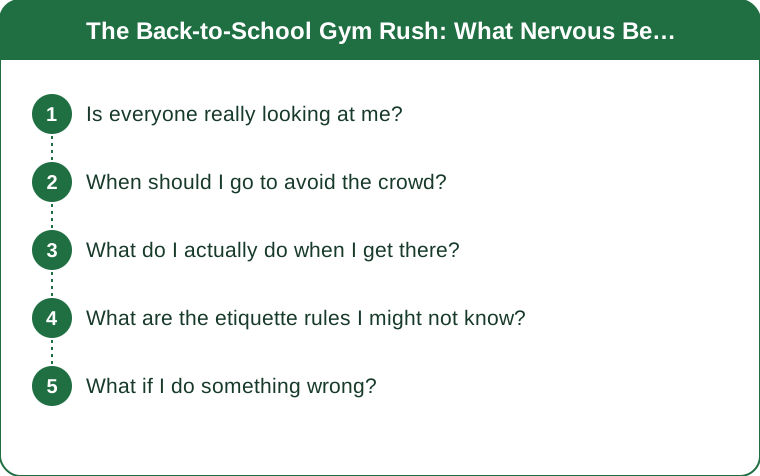
Is everyone really looking at me?
No, and the research on this is fairly clear.
Psychologists call it the spotlight effect — people consistently and substantially overestimate how much others notice them. In a gym, where most people are counting reps, managing rest timers, or watching their own form in a mirror, the overestimate is larger than usual.
Watch someone else for two minutes. You will notice how completely absorbed they are in their own set. That is what you look like to them.
The people who do look are usually checking equipment availability, which is the single most common reason anyone glances anywhere in a gym.
The uncomfortable exception: occasionally someone is genuinely rude, and it happens across every kind of gym. It reflects on them and it is rare enough that it should not shape your plans — and every gym has staff who will deal with it if it happens.
When should I go to avoid the crowd?
The reliable off-peak windows are early morning before 7am, mid-morning between 10am and noon, and mid-afternoon between 1pm and 4pm.
The peak is almost universally 5pm to 8pm on weekdays. If you are nervous, this is the window to avoid for your first month.
Weekend mornings after 10am are usually calmer than people expect, and Sunday afternoons are often the quietest hours of the entire week.
Many gym apps now show live occupancy. Check yours — this feature exists at most major chains and hardly anyone uses it.
The rush passes. The late-summer influx typically thins substantially within six to eight weeks, and by mid-autumn the gym returns to its baseline. If you can get through this stretch, the environment gets easier on its own.

What do I actually do when I get there?
Arrive with a written plan. This solves most of the anxiety by itself.
The anxiety is largely about not knowing what to do next. A list on your phone — exercise, sets, reps, weight — removes every moment of standing in the middle of the floor deciding.
A workable first plan: five exercises, three sets each, 45 minutes. A leg press, a chest press machine, a seated row, a lat pulldown, and a set of walking lunges. All machines except the last, all straightforward to learn.
Machines are legitimate. They guide the movement path, they have instructional diagrams on them, and they are safer to learn alone. Starting on machines and moving to free weights over a few months is a perfectly respectable path, not a lesser one.
Have a backup for every exercise. In a busy gym something will be occupied. Knowing your substitute in advance prevents the stall that turns into leaving early.
Bring headphones. They are a socially accepted signal that you are not available to talk, and they help enormously with the feeling of being observed.
What are the etiquette rules I might not know?
Do I have to wipe down equipment?
Yes, always, and it is the rule people care most about. Wipes or spray and paper towel are provided. This is the etiquette violation most likely to actually annoy someone.
Can I ask someone how long they will be?
Yes, and it is completely normal. Can I work in with you? is also standard on machines and racks — it means alternating sets, and most people say yes without hesitation.
Do I have to re-rack my weights?
Yes. Plates back on the tree, dumbbells back in the correct slot. This is the second most noticed thing.
How long can I stay on one machine?
During busy hours, be aware of whether people are waiting, and offer to let someone work in. Sitting on a machine scrolling your phone between sets is the behavior most likely to irritate people waiting.
Is it rude to ask staff for help?
The opposite — it is what they are there for, and most gyms include a free orientation session that a majority of members never use. Asking an employee to show you a machine is the most normal request in the building.
What if I do something wrong?
You will, and it does not matter.
Everyone loads a machine wrong, sits backwards on something, or cannot figure out a pin at some point. The experienced person next to you did all of it in their first year and has forgotten.
If you are unsure how a machine works, look at the diagram on it. Almost every machine has one. If it still is not clear, ask staff rather than guessing under load.
What if I am much weaker than everyone around me?
The range of strength in any gym is enormous and nobody is comparing. Start light, add weight gradually, and understand that everyone in the building started somewhere lower than where they are now.
What if I need to leave early?
Leave. A 20-minute workout you completed is worth more than a 60-minute one you dreaded so much you skipped. Shortening is a valid response to a bad day; quitting entirely is not.
How long until this feels normal?
Most people report the gym feeling routine somewhere between six and ten visits. The anxiety curve drops fast once the environment becomes familiar — which is an argument for frequency over intensity in month one.
The thing to hold onto: every confident person in that room was once standing where you are, and the only difference between them and you is a number of visits.
TL;DR: The crowd is temporary and the audience is imaginary.
- The late-summer rush thins within six to eight weeks. Get through it and the gym gets easier on its own.
- Avoid 5pm to 8pm weekdays. Early mornings, mid-morning, and Sunday afternoons are the quiet windows.
- Arrive with a written plan. Most gym anxiety is not knowing what to do next, and a list removes it.
- Machines are a legitimate starting point, with diagrams on them and a safer learning curve.
- Wipe equipment and re-rack weights. Those are the two rules people actually notice.
- Six to ten visits is when it typically starts feeling routine. Frequency beats intensity in month one.
Write five exercises on your phone tonight and go tomorrow at 10am. That is the entire first step.
See It in Motion
Seen here: High Waist Embossed Yoga Leggings with Side Pockets — shop it on bubblelime.com
Keep Reading
This article is for general informational and styling purposes only. Fit, sizing, and product availability may vary.