Your First Personal Training Session: What to Expect and How to Get Your Money's Worth
Quick Answer: Your first personal training session should be mostly conversation and a movement screen, not a punishing workout. Expect health history, goal discussion, a look at your squat, hinge, push, pull and balance, and some light measured work. A trainer who destroys you in session one is showing off, not assessing. Come with specific goals and three questions of your own — that’s what makes the hour pay.
Two fears show up at once: that the workout will be brutal, and that you’re about to be sold a twelve-month package by someone in a branded polo.
Both are manageable, and preparation handles both. Here’s what session one actually contains and how to leave it with a plan instead of a contract.

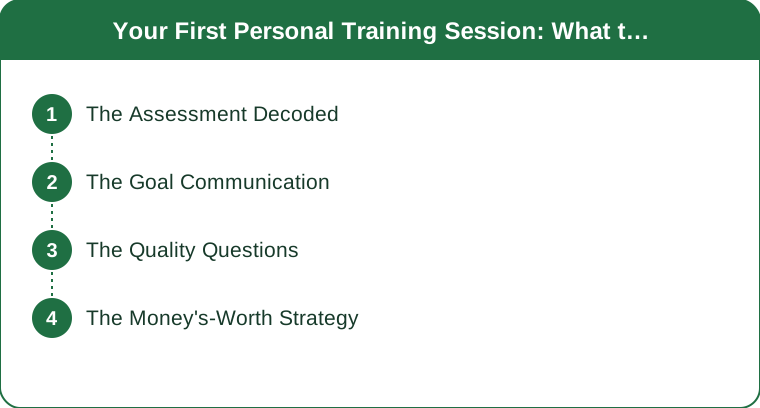
What Happens in a First Personal Training Session?
Roughly four parts, and the first is the longest.
1. The conversation (15–20 minutes). Health history, injuries current and old, medications if relevant, your schedule, your training background, what you actually want. A good trainer asks more than they demonstrate in session one. If you’re moving within the first three minutes, something is being skipped.
2. The movement screen (10–15 minutes). They’ll watch you do the five basic patterns: a squat, a hip hinge, a push, a pull, and something involving balance or single-leg stance. They may check shoulder and hip mobility. They’re reading your starting point, not grading you — there’s no passing score, and everyone has asymmetries.
3. A light workout (20 minutes). Some measured work to calibrate effort and see how you respond to coaching. It should be moderate. A first session that leaves you unable to walk down stairs for four days is a red flag, not a rite of passage — it tells you nothing useful and it’s likely to make you cancel session two.
4. The debrief (5–10 minutes). What they saw, what they’d program, and why. You should leave understanding their thinking. If you walk out confused about what happens next, that’s a communication failure and it’s theirs, not yours.
Say What You Actually Want (Specifically)
Trainers program what you name. “I want to tone up” gets you a generic plan, because it isn’t a goal — it’s a vibe.
Trade vague for specific:
- Not “get in shape” → “do one strict pull-up in six months.”
- Not “lose weight” → “carry my kid up two flights without getting winded, and feel strong doing it.”
- Not “get stronger” → “deadlift my bodyweight safely.”
Be honest about constraints, not aspirational. Tell them the real number of days you’ll train — two, if it’s two. Tell them your budget. Tell them which exercises you genuinely hate. A plan built for the life you actually have survives; a plan built for the person you intend to become in January doesn’t.
Disclose history fully. Old injuries, surgeries, conditions, and previous gym experiences good and bad. A trainer can only work around what they know. If you’re postpartum or dealing with pelvic floor or diastasis concerns, name it directly and look for a trainer with women’s-health-specific experience.
Consider naming a learning goal. “Teach me to train myself” is a completely legitimate brief, and many excellent trainers love this client. It frames the engagement as finite and buys you independence rather than dependence.

Three Questions That Reveal Trainer Quality
Interview them back. This is a hiring decision.
1. “Who do you usually train?” A trainer whose typical client resembles you — same age range, same goals, same starting point — has relevant pattern recognition. A specialist in competitive powerlifting may not be your best fit for returning to exercise at 45.
2. “How would you progress me over three months?” The answer you want includes assessment, a progression logic, and a re-evaluation point. The answer you don’t want is pure enthusiasm about how hard you’ll work.
3. “What do you do when I show up exhausted or sore?” This one is the most revealing question on the list. “We adjust — swap the session, reduce load, work on something else” is a coach. “We push through” is someone who will eventually injure you.
And the sales read: a trainer who talks packages and pricing before understanding your goals is selling. One who makes a specific recommendation after listening is coaching. That distinction decides whether you book session two.
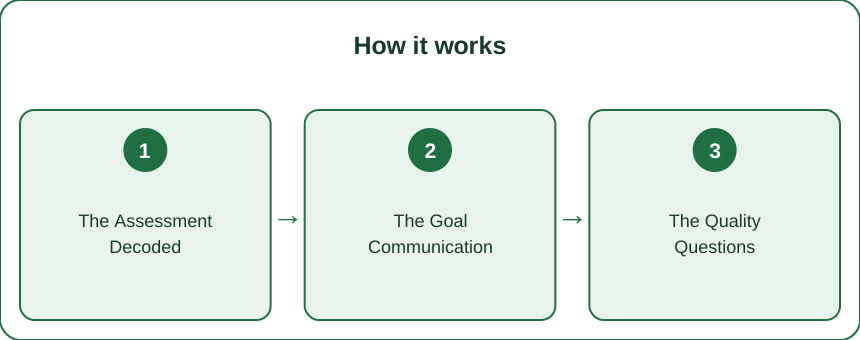
5 Mistakes Everyone Makes With Personal Training
1. Not taking notes. Spend three lines after every session: what you did, which cue made something click, what you want to ask next time. A paid hour compounds when it’s documented and evaporates when it isn’t.
2. Skipping the homework. The weekly session is the lesson; the two independent sessions in between are where progress happens. Without them, every session restarts from the same place.
3. Buying the big package immediately. Do a single session or a small block first. Chemistry and communication style matter enormously, and you can’t assess either from a website.
4. Staying quiet when something isn’t working. Trainers adjust based on feedback they receive. The silently dissatisfied client wastes their own money and the trainer never finds out why they left.
5. Assuming you need a trainer forever. The best outcome is needing less of it over time. A sensible structure: weekly for a month, then every two weeks, then monthly check-ins as your independence grows. A trainer who celebrates that trajectory was the right hire.
FAQ
How much does a personal training session cost?
It varies enormously by city and gym, typically ranging from budget chain rates to premium studio rates that can be several times higher. Small-group training and a front-loaded package that tapers to monthly check-ins both cut the cost substantially without losing much value.
Should I be sore after my first personal training session?
Mildly, at most. A first session is for assessment, not annihilation — a trainer who leaves you unable to sit down for three days learned nothing about you and made session two less likely. Some muscle soreness 24–48 hours later is normal; struggling to walk is not.
What should I wear and bring to my first session?
Comfortable athletic clothes you can move freely in, supportive trainers, a water bottle, and a towel. Bring a note on your phone with your injury history and your specific goals — it makes the intake conversation dramatically more useful in the time available.
TL;DR:
- Session one should be mostly conversation plus a movement screen, not a brutal workout.
- Name specific goals (“one pull-up in six months”), be honest about your real schedule.
- Ask who they usually train, how they’d progress you, and what they do when you’re exhausted.
- Packages pitched before goals are understood = sales. Recommendations after listening = coaching.
- Take three lines of notes after every session and do the between-session homework.
See It in Motion
Seen here: High Waist Embossed Yoga Leggings with Side Pockets — shop it on bubblelime.com
Keep Reading
This article is for general informational and styling purposes only. Fit, sizing, and product availability may vary.