The Free-Weight Area: A Field Guide for the Nervous
Quick Answer: The free-weight area feels intimidating because it runs on unwritten rules - and the fix is simply learning them, which takes one read and three visits. The core five: step back from the rack to lift, re-rack everything, a towel or bottle claims a bench, sharing is normal and has a script (how many sets do you have left?), and nobody is watching you - the mirrors are for form, and the headphones are real. Go off-peak, arrive with three exercises written down, and the room shrinks by half each visit.
The cardio section explains itself: machines with instructions, everyone facing forward. The free-weight area has no signage, visible experts, and a social code nobody hands you at the door. That gap - not the weights - is what the nerves are made of, and gaps can be closed.

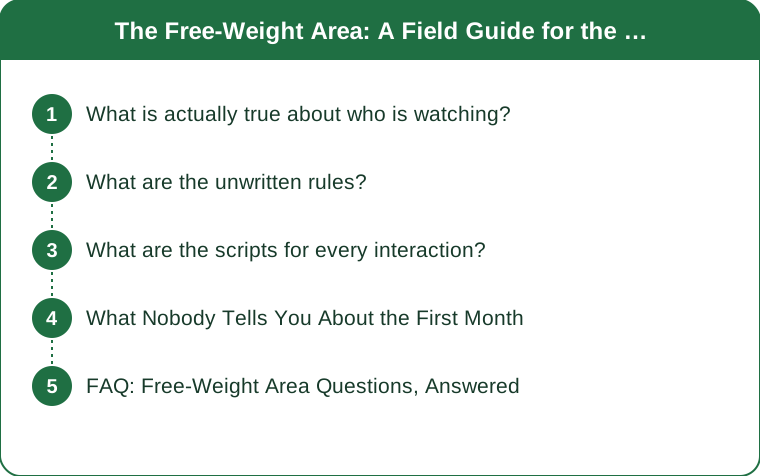
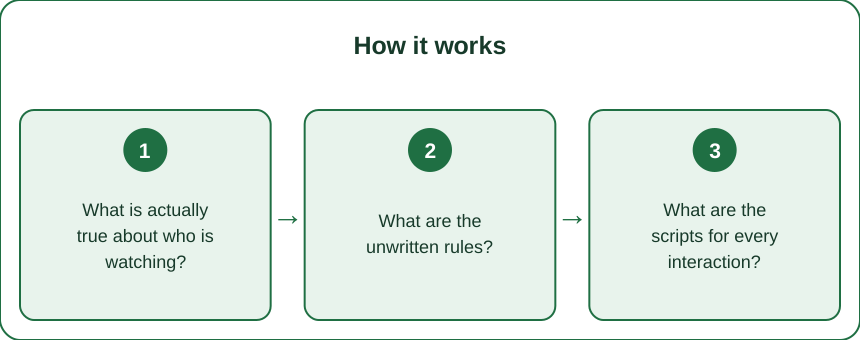
What is actually true about who is watching?
Almost nothing your nerves are telling you.
The spotlight effect is a documented bias. People consistently overestimate how much others notice them - classic psychology experiments found observers registered a fraction of what self-conscious subjects assumed. In a gym this bias runs at maximum: you feel like the room’s main character on day one, while the room is deep in its own programs.
Lifters are the most self-absorbed audience on earth, in the best way. Between counting reps, tracking rest timers, and watching their own form, regulars have no bandwidth left for critiquing a stranger’s dumbbell curls. The headphone bubble is real - most of the room is functionally alone in there.
The mirrors are tools, not judgment devices. Lifters watch themselves to check depth, path, and symmetry - it is the free version of a coach. When eyes seem pointed your way, you are almost always standing between someone and their own reflection, which matters for logistics (do not park in someone’s sightline mid-set) and not at all for self-worth.
The glances that do happen are equipment queries. Is she almost done with the 20s - is that bench free - that is the entire content of ninety-five percent of gym looking. Once you know the question behind the glance, the glance stops feeling like surveillance.
And the regulars remember being new. Every competent-looking person in that room had a first day, most of them awkward. The survey data on this is consistent and heartwarming: experienced lifters overwhelmingly report neutral-to-encouraging feelings toward obvious beginners. The villain audience does not exist; you are performing for an empty theater.
What are the unwritten rules?
Seven customs cover essentially everything. Learn them once and you have the local passport.
1. Step away from the rack to lift. Take the dumbbells two big steps back before starting your set. Standing at the rack blocks access to every weight behind you - it is the number one newcomer foul precisely because nobody explains it.
2. Re-rack your weights, in the right slots. The iron law. Plates come off bars when you finish; dumbbells return to their numbered homes. Fifteen seconds of tidying is the entire membership fee of the community.
3. A towel or bottle holds a station - briefly. Leaving your towel on a bench while you grab dumbbells is a legitimate claim; leaving it while you do twenty minutes elsewhere is squatting. Claim what you are using, release what you are not.
4. Sharing is normal and expected. Benches, racks, and machines all time-share during busy hours. The mechanism is called working in - alternating sets during each other’s rests - and asking for it is standard, not cheeky.
5. Give lifting space and sightlines. Do not walk close behind someone mid-deadlift, and avoid strolling between a lifter and the mirror during a set - wait the thirty seconds or loop around.
6. Wipe what you sweat on. Benches especially.
7. Keep phone calls out and phone camera angles considerate. Texting between sets is universal; filming that captures strangers is the etiquette frontier - frame yourself, not the room.
That is the entire code. No rule requires strength, experience, or special clothing - a first-day beginner following these seven reads as a regular by the second visit.

What are the scripts for every interaction?
Nerves hate improvising. Memorize five sentences and there is nothing left to improvise.
Claiming and confirming: Are you using this bench? - and its sibling - Are these 15s free? Four words, universal, and the answer is almost always a friendly nod.
The queue question: How many sets do you have left? This is the standard, polite, completely expected way to signal you want equipment next. Nobody hears it as pressure; everyone hears it as the normal economy of a shared room.
The share: Mind if I work in? - meaning you alternate during their rests. On benches and racks this is routine; with dumbbells it is rarer (you would share the pair), so the queue question usually serves better there.
The graceful decline of unsolicited advice: Thanks - I am following a program, but appreciate it. Warm, closed, complete. Unrequested form coaching happens occasionally; a cheerful boundary ends it without a scene, and one earbud left visibly in reduces its frequency to almost never.
The staff walkthrough request: Could someone show me the free-weight area and how the racks work? This is literally the front desk’s job, costs nothing, and converts a mysterious room into a labeled one in ten minutes. The members who seem to know everything mostly just asked earlier than you.
Delivery notes: eye contact optional, smiling helps, and removing one earbud to speak is the universal signal of good faith. Every script above is exchanged ten thousand times a day in every gym on earth - you are not interrupting the culture, you are speaking it.
What Nobody Tells You About the First Month
Off-peak is a different, kinder room. Weekday mid-mornings and early afternoons run at a fraction of the 5-to-7 p.m. crush - more open benches, shorter waits, and space to move slowly through new exercises. Late August is a bonus window: the September resolution-and-semester wave has not landed yet, so the next few weeks are the softest on-ramp of the season. If your schedule allows even one off-peak visit, spend your first one there.
Arrive with the workout already written. Three exercises, sets, and target weights in your notes app - decided at home, not composed mid-room under fluorescent lighting. A plan converts wandering (the thing that feels conspicuous) into purpose (the thing that reads as belonging). Visit one: goblet squats, dumbbell bench or floor press, one row variation. Done in twenty-five minutes, confidence banked.
Clothes you trust are one less open browser tab. This is not about looking the part - it is about never once thinking about your outfit mid-set. Squat-proof leggings you have already tested at home, a top that stays put when you hinge, shoes with flat stable soles. When the high-waisted leggings hold through every warm-up move without a single tug, that entire category of self-consciousness closes for the session.
Use the three-visit ladder. Visit one: dumbbells only, off-peak, three exercises. Visit two: same workout plus a bench and one new movement. Visit three: introduce the squat rack or ask staff for a rack orientation. Competence compounds fast when each visit adds exactly one thing.
And log something every session. Weights used, reps done, one line of notes. Within three weeks the numbers move - and watching your own progression is the point where the room finishes shrinking, because your attention has moved from who might be watching to what you are building.
FAQ: Free-Weight Area Questions, Answered
How do I ask to share equipment without being awkward?
Use the two standard scripts: How many sets do you have left? to queue for equipment, and Mind if I work in? to alternate sets on a bench or rack. Both are heard daily by every regular and read as normal gym economics, not intrusion. Remove one earbud, smile, four words - the interaction is over in five seconds.
What if someone corrects my form?
Occasionally someone will offer unsolicited tips - usually well-meant, occasionally unwanted. The graceful close: Thanks, I am following a program. If advice ever comes with hovering or persistence, staff exist precisely for that conversation. For form peace of mind, film your own sets from the side or book one session with a trainer to pressure-test the basics.
When is the free-weight area least crowded?
Weekday mid-mornings and early afternoons are the reliable valleys; 5 to 7 p.m. is the peak everywhere. Right now - late August - is a seasonal sweet spot before the September rush arrives. One off-peak first visit buys you space to learn the room at your own pace.
Do experienced lifters judge beginners?
The evidence and every survey say overwhelmingly no - regulars are absorbed in their own training, remember their own first days, and skew supportive toward anyone showing up. The judgment you feel is the spotlight effect, a documented bias where everyone overestimates how much they are noticed. The room is busier with itself than with you.
TL;DR:
- The fear is a knowledge gap, not a strength gap - the room runs on seven learnable customs.
- Core code: lift away from the rack, re-rack everything, towels claim briefly, sharing is normal, wipe your bench.
- Memorize the scripts: how many sets left, mind if I work in, thanks - I am following a program.
- Go off-peak with three exercises pre-written; add one new thing per visit for three visits.
- Nobody is watching - the spotlight effect is a bias, the mirrors are tools, the headphones are real.
The free-weight area was never guarding a secret. It was waiting for you to learn five sentences and bring a plan - and by visit three, you are the furniture someone else is nervous about.
See It in Motion
Seen here: High Waist 8” Yoga Shorts — shop similar styles on bubblelime.com
Keep Reading
This article is for general informational and styling purposes only. Fit, sizing, and product availability may vary.