Crossing Into the Free Weight Zone: A First-Timer's Field Manual
There’s an invisible line on the floor of every gym. On one side: machines, padded seats, little diagrams showing you exactly what to do. On the other: the free weight zone, where people grunt, chalk exists, and everyone seems to know something you don’t.
You’ve been eyeing that side for weeks. Here’s the thing — it’s just weights on a rack. Nobody’s guarding it. Let’s walk you across.
Quick Answer: The free weight area has exactly four etiquette rules (re-rack your weights, don’t hover mid-set, claim space with a towel, don’t camp in front of the mirror). Start with three moves — goblet squats, dumbbell rows, dumbbell presses — for 3 sets of 8–10 with a weight you can clearly control. Walk in with a written plan, use one small corner, and by your third session it’s just where you train.

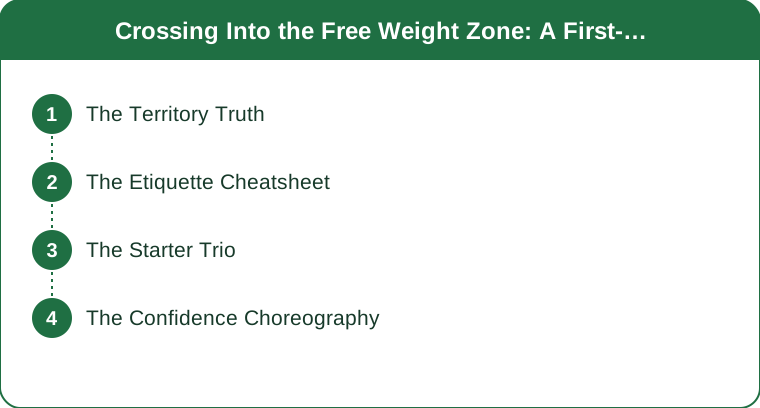
Is Everyone in the Free Weight Area Actually Watching Me?
No. And this isn’t a pep talk — it’s just how attention works in a gym.
Everyone in that zone is running their own program. They’re counting reps, watching a rest timer, thinking about whether to add five pounds, or half-dissociating into a podcast. The people staring intently at the mirrors are checking their own knee position, not scanning the room for beginners.
This shows up consistently whenever anyone surveys gym-goers: a large majority report feeling self-conscious and worrying about being judged, while almost nobody reports actually judging anyone else. Everyone in the room feels watched. Almost no one is watching. The gatekeepers you’re imagining are, statistically, also busy imagining their own gatekeepers.
The other thing worth knowing: on the rare occasion a regular does notice you, it’s usually because they want to know if you’re done with the bench. That’s it. That’s the whole interaction.
What Are the Rules of the Free Weight Area?
The entire unwritten rulebook, now written. There are four.
1. Re-rack your weights. This is the one commandment. Dumbbells go back in the right slot, in order. Plates come off the bar and go on the tree. If you learn nothing else, learn this — it’s the single behavior that separates “new person” from “annoying person,” and it takes fifteen seconds.
2. Don’t hover over someone mid-set. Standing three feet away waiting for a rack is standard practice and totally fine; standing three feet away while they’re lifting is not. Wait for the rest window between sets, then ask: “How many sets do you have left?” Nine times out of ten you’ll get an answer and an offer to work in.
3. Claim your space, politely. A water bottle or towel on the bench means “I’m using this, I stepped away for thirty seconds.” Use it. Don’t use it to reserve three stations at once during peak hours.
4. Mirror-blocking is forgiven briefly, noted permanently. Standing in front of the dumbbell rack or the mirror for a moment between sets is normal. Setting up your entire workout directly in front of the rack so nobody can reach the 20s is the thing that gets you quietly resented.
That’s it. Four rules. You now know the etiquette better than a meaningful share of the people already in there.

What Should Your First Free Weight Workout Actually Be?
Three moves. All you need is two dumbbells and a bench.
Goblet squat — Hold one dumbbell vertically against your chest, both hands cupping the top end. Feet a bit wider than shoulders. Sit down between your hips, keep your chest tall, stand up. 3 sets of 8–10. The dumbbell at your chest acts as a counterweight, which makes this the most forgiving squat variation there is — it basically corrects your form for you.
One-arm dumbbell row — One knee and one hand on a bench, back flat and roughly parallel to the floor, other hand holding a dumbbell hanging straight down. Pull it to your ribs, lower it under control. 3 sets of 8–10 per side.
Dumbbell press — Flat on a bench or lying on the floor, a dumbbell in each hand at chest level. Press up, lower slowly. 3 sets of 8–10. The floor version limits your range of motion, which is actually a nice safety feature for a first session.
Rest 60–90 seconds between sets. The whole thing takes about 25 minutes. Do it twice a week and by week two, that corner of the gym will feel like yours.
On picking weights: start lighter than your ego wants. If you can’t do 8 clean reps with control, it’s too heavy. If you could do 20, go up. Nobody in that room is impressed by weight — they’re all aware that anyone can pick up something too heavy and move it badly. Control is the thing that actually reads as “knows what they’re doing.”
5 Mistakes Everyone Makes on Their First Free Weight Session
1. Walking in without a plan. This is the biggest one. Wandering around deciding what to do next is what actually makes you feel exposed — it’s the standing still, not the lifting. Write three exercises on your phone before you leave the house. Purpose reads as belonging, and more importantly, it feels like belonging.
2. Going too heavy on day one. You’ll either fail a rep publicly (which is fine but feels awful when you’re new) or use terrible form. Neither helps. Start conservative; you can add weight next session.
3. Trying to use the whole area at once. Grab two dumbbells, find a corner or an open bench, and stay there. You don’t need to migrate across four stations. One small plot of land is plenty.
4. Dressing for the wrong workout. Free weights involve bending, rowing, and squatting deeply — much more range of motion than a seated machine circuit. A pair of squat-proof high waist leggings and a top that stays put when you hinge forward removes an entire category of distraction you don’t need on your first day.
5. Skipping the mirror out of self-consciousness. The mirrors are a form tool, not a vanity feature. Use them to check your knee tracking on squats and your back position on rows. Watching yourself is the point.
FAQ
Do I need a spotter for dumbbell exercises?
Not for the starter trio. Goblet squats, rows, and dumbbell presses can all be safely bailed out of on your own — with dumbbell presses, you simply lower the weights to the sides or let them down to your chest. Spotters become relevant with barbell bench press and heavy barbell squats, which are further down the road.
How do I ask someone if I can work in with them?
Wait until they’re between sets, make eye contact, and say “Mind if I work in?” That’s it. It’s an extremely normal request and most people say yes immediately. If they’re doing something heavy that requires long setup, they might say they’d rather not — that’s normal too, not a rejection.
How long until I stop feeling out of place?
Usually about three sessions. That’s not a metaphor — it’s roughly how long it takes for the physical space to become familiar enough that your brain stops flagging it as unfamiliar territory. Frequency matters more than duration here: three short sessions in a week will normalize the space faster than one long session a week for three weeks.
TL;DR:
- Everyone feels watched; nobody is watching. The regulars are deep in their own programs.
- Four rules total: re-rack, don’t hover mid-set, claim space with a towel, don’t camp at the mirror.
- Starter trio: goblet squats, dumbbell rows, dumbbell presses — 3 sets of 8–10, 60–90s rest, about 25 minutes.
- Go lighter than your ego wants. Control reads as competence; weight doesn’t.
- Bring a written plan. Wandering is what makes you feel exposed, not lifting.
- Claim one corner and two dumbbells. By session three, it’s just where you train.
See It in Motion
Seen here: Racerback Tank Top - White — shop similar styles on bubblelime.com
Keep Reading
This article is for general informational and styling purposes only. Fit, sizing, and product availability may vary.