What Gym Intimidation Is Actually About (It's Rarely What You Think)
Quick Answer: Gym intimidation usually breaks down into a few specific, addressable causes — not knowing how equipment works, uncertainty about gym etiquette (how long to rest between sets, whether you can “work in”), and fear of visible incompetence in front of strangers — rather than a vague general fear that generic confidence advice tends to target.
Treating gym anxiety as one big feeling misses that it’s usually 2-3 specific, nameable uncertainties, each of which has a concrete fix.

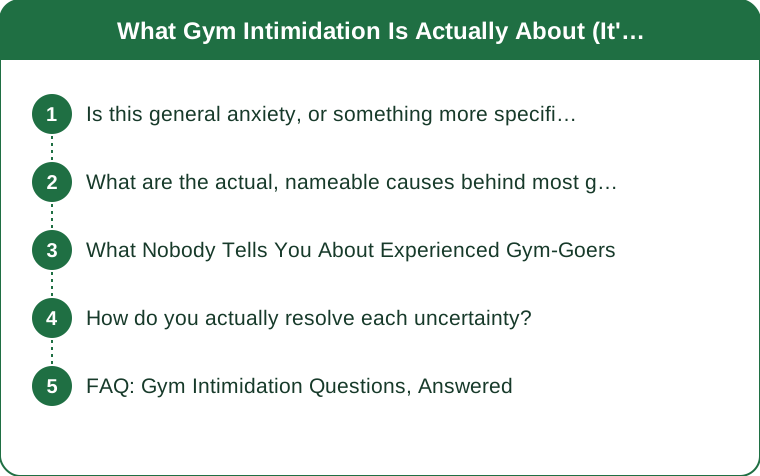
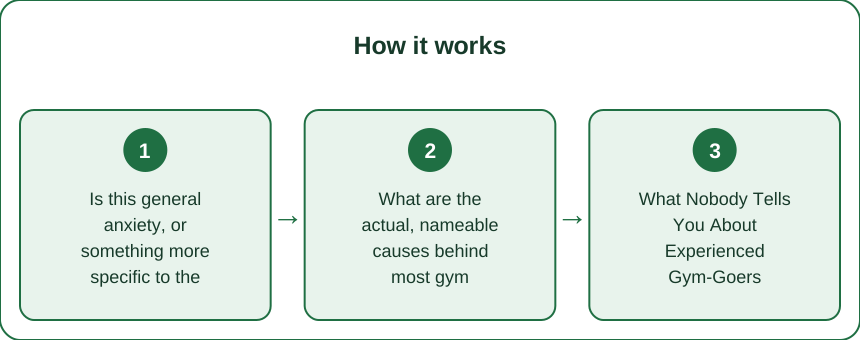
Is this general anxiety, or something more specific to the gym?
What’s the difference between general anxiety and gym-specific intimidation?
General social anxiety is a broader pattern that shows up across many situations; gym-specific intimidation is usually narrower and tied to specific unknowns — equipment operation, unspoken etiquette, unfamiliar movement patterns — that resolve with concrete knowledge rather than broad anxiety management.
Is it actually about being watched, or something more specific?
Most people report the fear isn’t really “everyone is watching me” in a diffuse sense — it’s the much more specific fear of visibly not knowing how a machine works or using bad form in front of someone who clearly knows what they’re doing.
What are the actual, nameable causes behind most gym intimidation?
- Equipment uncertainty — not knowing how to adjust a machine, what a cable attachment does, or how to load a barbell correctly
- Etiquette uncertainty — not knowing if you can ask to work in on a machine, how long is too long to rest, whether re-racking weights is expected
- Movement uncertainty — not being confident in proper form for an exercise, worried about looking wrong rather than just unfamiliar
- Space uncertainty — not knowing which areas are for which purpose (free weight zone vs. machine zone vs. functional area)
Each of these is a specific, learnable thing — not a personality trait or a permanent gym feeling.

What Nobody Tells You About Experienced Gym-Goers
Here’s the part that surprises people: most regular gym-goers are focused on their own workout, not observing yours — this isn’t just reassurance, it’s a genuinely common finding in how people report their own gym attention. The person who looks confident and locked-in is very often not tracking what you’re doing at all, because they’re managing their own rest timer, form cues, and next set.
The visible confidence of experienced lifters usually comes from having resolved the four uncertainties above through repetition, not from some innate fearlessness that beginners lack.
How do you actually resolve each uncertainty?
- Equipment: Look up a 60-second tutorial video for unfamiliar machines before your session, or ask staff for a quick walkthrough — most gyms expect and welcome this
- Etiquette: Default rules that work almost everywhere — ask before working in, re-rack your weights, don’t rest on a machine during your entire scroll break if others are waiting
- Movement: A single session with a trainer or knowledgeable friend to check form on your main lifts resolves most form anxiety faster than months of solo uncertainty
- Space: Walk the gym once during a quiet time (many gyms are emptiest early morning or midday) just to see the layout without pressure to perform
FAQ: Gym Intimidation Questions, Answered
Does gym intimidation ever fully go away?
For most people, yes, largely — once the specific uncertainties (equipment, etiquette, movement, space) resolve through repeated exposure, the general anxious feeling tends to fade with it, since it wasn’t a separate, persistent thing.
Is it normal to still feel some nerves even as an experienced gym-goer?
Somewhat, especially in a new gym or trying an unfamiliar piece of equipment — even experienced lifters report a version of this in genuinely new situations, it’s just narrower and resolves faster with their existing baseline knowledge.
Does going with a friend actually help?
Often yes, particularly for the etiquette and space uncertainties, since a friend who already knows the gym’s norms can transfer that knowledge quickly — though it’s less useful for resolving personal form or equipment knowledge gaps long-term.
TL;DR:
- Gym intimidation is usually 2-4 specific, nameable uncertainties, not one vague fear
- Equipment, etiquette, movement, and space are the four most common categories
- Most experienced gym-goers are focused on their own workout, not observing yours
- Each uncertainty has a concrete, learnable fix — a tutorial, a form check, a quiet-time gym walkthrough
See It in Motion
Seen here: UPF 50+ Racerback Yoga Tank Top — shop it on bubblelime.com
Keep Reading
This article is for general informational and styling purposes only. Fit, sizing, and product availability may vary.