The Gym Is Packed and You Have 30 Minutes. Now What?
Quick Answer: Have a plan B built before you arrive. The reliable structure is one pair of dumbbells or one cable station, claimed once and used for the whole session, running three or four movements in a circuit. This removes every wait, every negotiation and every decision. Thirty focused minutes on a packed floor beats sixty spent queuing, and nothing about a busy gym requires you to talk to anyone.
Autumn is when this starts happening — everyone comes back indoors, and the floor you had to yourself in July has a queue for the squat rack.
Here is how to train anyway, answered in the order the anxiety usually arrives.

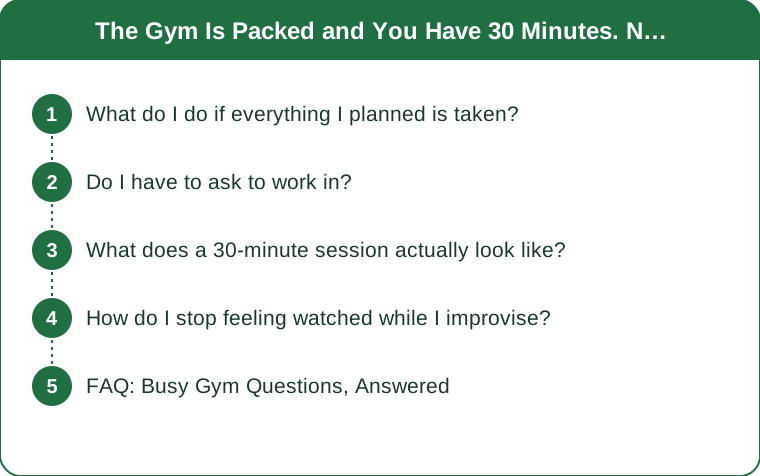
What do I do if everything I planned is taken?
Switch to a movement-pattern plan rather than an exercise plan, and the problem largely dissolves.
Think in patterns, not machines. A session is really: push, pull, hinge, squat, carry. Each pattern has half a dozen exercises that train it. If the leg press is taken, the pattern is still available via goblet squats, split squats, or a dumbbell squat in any free corner.
Write your substitutions before you go. A note on your phone with three options per pattern turns a stressful moment into a lookup. This takes ten minutes once and works for the rest of the year.
Default to dumbbells. Most gyms have multiple pairs of every weight, which means a dumbbell exercise is almost never fully blocked. A single pair plus a small patch of floor supports a complete session.
What if even the dumbbells I want are taken?
Go lighter and slower. A weight one increment lighter with a three-second lowering phase and a pause is genuinely hard, and often a better stimulus than the weight you wanted. This is a real training method, not a consolation prize.
Should I just wait for the rack?
Rarely worth it on a packed floor. Ten minutes waiting is a third of a thirty-minute session, and you cannot know how long the wait will be. Substitute and keep moving.
Do I have to ask to work in?
No. It is normal, and it is also entirely optional, and nobody is keeping score.
Working in is standard gym etiquette — asking to alternate sets with someone using a station is a completely ordinary request and most people say yes without a thought. If you want to use it, the script is four words: mind if I work in? You do not need more than that, and you do not need to explain yourself.
And if you would rather not ask, do not. There is a persistent implication that avoiding the ask is a confidence failure to be overcome. It is not — it is a preference, and a session built around equipment you can claim outright is a completely legitimate way to train indefinitely. Plenty of experienced lifters structure their sessions this way in busy hours purely because it flows better.
What if someone asks to work in with me?
Say yes if you are comfortable, and it is fine to say no if the setup is complicated — sorry, I have got a few sets left with this setup is a complete and acceptable answer. Nobody is entitled to your station mid-set.
What if someone is sitting on a machine on their phone?
This is the most common source of quiet resentment on a gym floor. You are entirely within your rights to ask if they are still using it, and most people apologise and move. If asking is not something you want to do, substitute and move on — it costs you less than the irritation does.
Is it rude to take two pairs of dumbbells?
On a very busy floor, yes, mildly. One pair plus bodyweight movements is the considerate version and it is also simpler.

What does a 30-minute session actually look like?
One station, three or four movements, minimal rest. This structure survives any crowd.
What is the simplest effective format?
Pick a pair of dumbbells and a patch of floor. Run four exercises back to back — for example a goblet squat, a dumbbell row, a Romanian deadlift and a press — for 8 to 12 reps each, rest a minute, and repeat for three to four rounds. That is a complete full-body session in under thirty minutes and it requires nothing you have to queue for.
Is a circuit as good as straight sets?
For strength at very heavy loads, no. For everything most people are training for — muscle, general strength, conditioning, consistency — a circuit of compound movements with adequate load is highly effective, and it is enormously better than a straight-set session that does not happen because the rack was busy.
What if I only get one thing done?
Then do the most important thing. If your session has a priority lift, do it first, at whatever station you can get, and treat everything after as a bonus. Most people run their session in the order they wrote it rather than in order of importance, and on a short day that means the priority lift is the one that gets dropped.
Are cardio machines a reasonable fallback?
If every weights option is genuinely gone, a hard twenty minutes on a bike or rower is a real session, not a waste of a trip. It is also the fallback most likely to be available in the evening rush.
How do I stop feeling like it does not count?
By defining what counts before you arrive. Success today is thirty minutes of hard work in the building is a target you can hit on any floor, on any day. A session judged against an ideal one you did not get to do will always feel like a failure, and that judgement is the thing that erodes attendance.
How do I stop feeling watched while I improvise?
Mostly by knowing that the premise is wrong, and partly by having enough structure that you are not visibly deciding.
Is anyone actually watching?
Overwhelmingly no. People in gyms are managing their own set, their own rest timer, their own reflection and their own discomfort. Research on the spotlight effect consistently finds people dramatically overestimate how much others notice them. On a packed floor there is even less attention available, not more.
Why does improvising feel more exposed than following a plan?
Because standing still and looking around reads to you as visible indecision. The fix is not confidence, it is having the substitution list ready so you move directly from one thing to the next. Nobody can tell the difference between plan A and plan C, and the internal experience is completely different.
Where should I go if I want less traffic?
The edges of the floor, the stretching area and the corner by the mats are nearly always freer than the centre. A single pair of dumbbells in a quiet corner is a complete gym, and it is a legitimate choice rather than hiding.
When is the gym actually quietest?
Generally early morning and mid-afternoon, with the crush between roughly 5pm and 7.30pm on weekdays. If your schedule has any flexibility, shifting by ninety minutes changes the experience more than any strategy in this article.
Does it get busier at this time of year?
Yes, noticeably and predictably. Attendance climbs through autumn as outdoor training gets less appealing and again in January. The floor in October is genuinely more crowded than the floor in July — the experience is not you becoming less tolerant.
What if I leave without finishing?
Then you did thirty minutes of training instead of none, and consistency across months is what produces results. A short session on a busy day is a deposit, not a failure.
FAQ: Busy Gym Questions, Answered
How long is it acceptable to occupy a machine?
Generally through your working sets with normal rest — a few minutes. Sitting on it between sets scrolling is what draws irritation, not the sets themselves.
Can I ask someone how many sets they have left?
Yes. It is a normal question and most people answer helpfully. If asking is not for you, substitute instead — both are fine.
Should I book a class instead on busy evenings?
It is an underrated solution. A booked class guarantees space, equipment and a structure, which removes the entire problem on the nights you know will be worst.
Is it worth going if I only have 20 minutes?
Yes. One pair of dumbbells, three movements, four rounds. Twenty focused minutes is a real training stimulus and far more valuable than the session you skipped.
What should I have on my phone before I go?
A three-line plan and a substitution list per movement pattern. It is the single highest-value thing you can prepare, and it takes ten minutes once.
Does everyone else find this stressful too?
Yes, including people who look completely at ease. Crowding, waiting and uncertainty are the most commonly cited gym frustrations at every experience level. It is a shared condition of a busy room, not a beginner problem.
TL;DR:
- Plan in movement patterns, not exercises, and write three substitutions per pattern before you go.
- One pair of dumbbells plus floor space is a complete session and is almost never fully blocked.
- Working in is normal — and choosing not to ask is equally valid. Build the session so you never need to.
- Do the priority lift first, not in the order you wrote it. On a short day that is the difference.
- The spotlight effect is real: people notice you far less than you think, and less still on a crowded floor.
Autumn crowds are predictable. Shifting your session by ninety minutes changes more than any tactic here.
See It in Motion
Seen here: Racerback Tank Top - White — shop similar styles on bubblelime.com
Keep Reading
This article is for general informational and styling purposes only. Fit, sizing, and product availability may vary.