Navigating the Packed Gym: Peak-Hour Strategies That Keep Your Workout Intact
Quick Answer: Peak gym hours are weekdays 5–7pm, with a smaller rush at lunch and around 7–9am. To survive them, write your workout as movement patterns (“a squat, a row, a press”) rather than specific machines, keep a substitute ready for every exercise, and learn to ask “mind if I work in?” Shifting your arrival by 30–45 minutes often halves the crowd.
The 6pm gym is a different sport. Three people orbiting the squat rack. Every 20 lb dumbbell simultaneously in use somewhere. A guy on the leg press scrolling his phone with the serene confidence of someone who has nowhere to be.
You can’t fix the crowd. You can build a workout that doesn’t care about it.

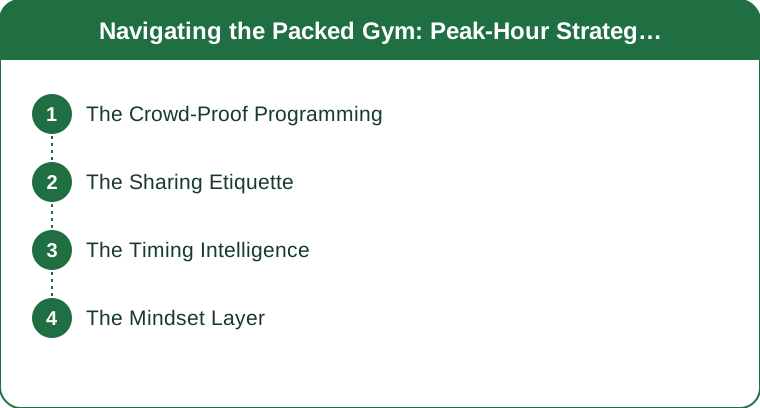
Write Patterns, Not Machine Names
This is the whole strategy and it takes five minutes to implement.
A rigid program — “leg press, lat pulldown, chest press, in that order” — queues, because it requires three specific machines to be free in a specific sequence. A pattern-based program — “a squat pattern, a horizontal pull, a horizontal push” — fills from whatever’s available and flows continuously.
Build a plan-B library. For every exercise, decide the substitute in advance, before you’re standing frustrated on the gym floor:
- Squat pattern → barbell squat / goblet squat / leg press / Bulgarian split squat / hack squat
- Horizontal pull → barbell row / dumbbell row / seated cable row / chest-supported row
- Horizontal push → bench press / dumbbell press / machine press / push-ups
- Hinge → deadlift / Romanian deadlift / hip thrust / back extension
- Vertical pull → pull-up / lat pulldown / assisted pull-up
Any one of these gets you the same training effect. Having the list decided beforehand is what turns a 15-minute wait into a 15-second decision.
Use supersets to claim one station. Grab a pair of dumbbells and a bench and run three or four exercises there — press, row, split squat, curl. You occupy one small area, use it fully, and never wait. Density training happens to suit dense gyms.
Know which equipment survives peak. Dumbbells, cables, and floor space are relatively abundant. Squat racks, leg presses, and popular machines are the bottlenecks. Schedule barbell work off-peak and accept that Tuesday at 6pm is a dumbbell-and-cable day.
The Sharing Etiquette Nobody Explains
The crowded floor runs on small negotiations, and the people who make them finish their workouts.
Working in is normal. “Mind if I work in?” is a completely standard question and the answer is almost always yes. You alternate sets. On machines it costs a few seconds of adjustment; on dumbbells it costs nothing.
Ask how many sets are left. “How many more do you have?” gets you a real answer and lets you plan. This is the single most useful sentence in a crowded gym.
One station at a time during rush. Draping a towel over three machines to run your own private circuit is off-peak behavior. At 6pm it’s the primary gym foul.
A water bottle reserves a station for about five minutes. Not twenty.
Phone between sets is fine; phone on the equipment isn’t. Machine camping while scrolling is the behavior everyone complains about. Sit, rest, stand up, let someone work in.
Trim rest at peak. A rack session that takes 45 minutes reads very differently at 6pm than at 2pm. Cut your rest a little, move on a little sooner, and re-rack your weights.

When Are Peak Gym Times, Actually?
- Weekdays 5–7pm — the universal crush. Worst on Monday, easing by Friday.
- Weekdays 7–9am — a solid pre-work rush, but shorter and it clears fast.
- Weekday lunch, 12–1pm — a mini-rush that empties by 1:15.
- Weekday 2–4pm — the genuinely open water.
- Friday evening — often a ghost town. The best-kept secret in gym scheduling.
- Weekend mornings 9–11am — busy; weekend afternoons are usually quiet.
Shift your arrival 30–45 minutes. Turning up at 7:15pm rather than 6:00 means you arrive as the 6pm wave leaves. It’s the cheapest fix available and it often halves the crowd.
Read the class schedule for its side effects. A 6pm group class pulls exactly the people who would otherwise be on the floor. The 15 minutes after a popular class starts is a reliable window.
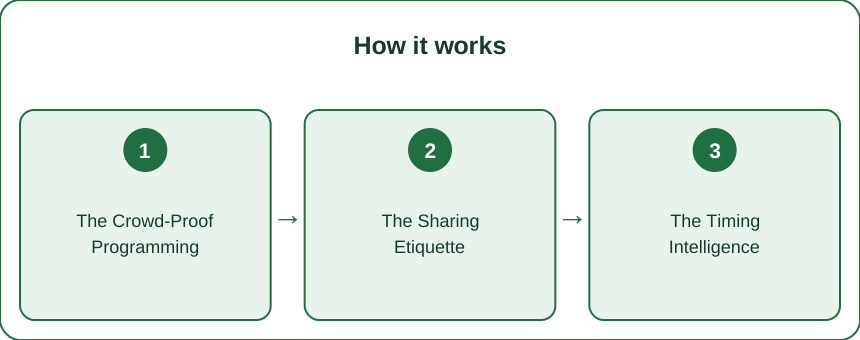
What Nobody Tells You About the Busy Gym
- The crowd is people doing the same good thing you are. Irritation spent on queues is workout energy misfiled. It’s a genuinely reframe-able annoyance.
- Waits are free mobility time. Hip openers while the rack clears, thoracic rotations between stations. Peak hours schedule your mobility work for you.
- Your time slot has regulars, and they become familiar faces. Most gym friendships happen at peak hours, because that’s where the same people keep showing up. The crowd is the community arriving.
- Grade the session on done-versus-skipped. A flexible workout that happened beats a perfect one that queued out and got abandoned. Adherence wins the year; optimality wins arguments on the internet.
FAQ
What time is the gym least busy?
Weekday afternoons between 2 and 4pm are consistently the quietest, followed by Friday evenings and weekend afternoons. Early morning before 6am is also open, though the equipment you want may be shared with the small dedicated crowd that trains then.
Is it rude to ask to work in with someone?
No — it’s standard gym etiquette and most people expect it, particularly during peak hours. Ask clearly, wait for them to finish their current set, and reset the equipment to their settings when you’re done.
How do I get a full workout when the gym is packed?
Write your program as movement patterns with pre-decided substitutes, superset two or three exercises at a single station, and lean on dumbbells and cables rather than the bottleneck machines. Most people can complete a full session at 6pm this way with no waiting at all.
TL;DR:
- Peak is weekdays 5–7pm; 2–4pm and Friday evenings are the open water.
- Write patterns, not machine names, and pre-decide a substitute for every exercise.
- Superset at one station to claim a small space and use it fully.
- Working in is normal — ask “mind if I work in?” and “how many sets left?”
- Shifting your arrival 30–45 minutes often halves the crowd.
See It in Motion
Seen here: UPF 50+ Short Sleeve Rashguard Swim Shirt — shop it on bubblelime.com
Keep Reading
This article is for general informational and styling purposes only. Fit, sizing, and product availability may vary.