How Do You Ask Someone How Many Sets They Have Left?
Quick Answer: Wait until they finish a set, make eye contact, and say how many sets do you have left? or mind if I work in? That is the entire script. It is a completely standard exchange that experienced gym-goers have several times a week, and the overwhelmingly common response is a number or a yes. The part worth practicing is not the question - it is what you do when the answer is four more sets.
Almost everyone finds this harder than the training. It is also the single skill that most changes how a busy gym feels.

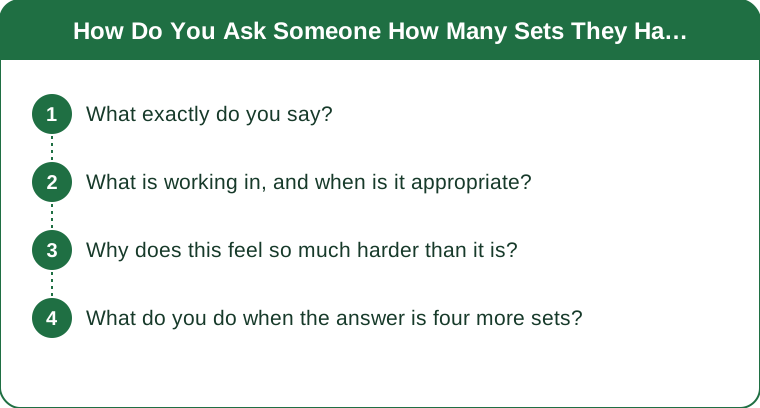
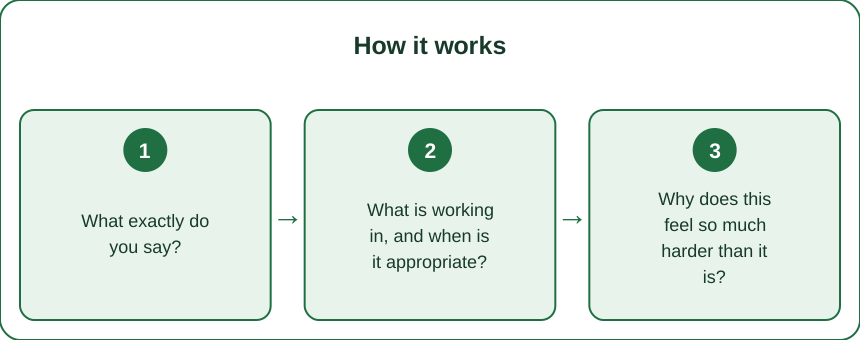
What exactly do you say?
Short, direct, and during a rest period. Length is what makes it awkward.
Wait for the set to end. Never interrupt mid-set - it breaks concentration and can be genuinely unsafe under a heavy load. Stand where they can see you, in their eye line but not in their space.
Then say one of two things: how many sets do you have left? or mind if I work in?
That is the whole script. No apology, no preamble, no explanation of your program. Longer openings make the exchange more awkward for both people, not less.
Headphones are not a barrier. A small wave in their field of vision is standard and expected. Everyone wearing headphones in a gym is accustomed to being flagged down this way.
And accept the answer as given. If they say four sets, that is information, not a negotiation. The single most useful skill here is hearing an inconvenient answer without treating it as a rejection.
What is working in, and when is it appropriate?
Alternating sets on the same equipment during each other’s rest periods. It works well on some equipment and badly on others.
Working in suits fixed machines and cable stations. Weight changes are fast, there is no setup, and the rest intervals line up naturally.
It is harder on barbells with big weight differences. If they are squatting 100 kg and you are squatting 40, stripping and reloading plates each set is slow and irritating for both people. In that case, waiting is often genuinely faster than working in.
Rest periods have to be compatible. If they are resting three minutes on heavy sets and you rest sixty seconds, working in disrupts both programs. It is reasonable to say that and wait instead.
Racks and platforms are the hardest cases. Setup is involved and safety matters, so many people prefer not to share these. That preference is legitimate.
And you can decline being worked in with. If someone asks and it does not work for your session, sorry, I have got three heavy sets left, about ten minutes is a complete and polite answer. Directness is the courtesy here.

Why does this feel so much harder than it is?
Because of a well-documented gap between how much attention you think you are getting and how much you actually are.
People systematically overestimate how much others notice them. This is a robust finding, and a gym amplifies it - mirrors, unfamiliar movements, and the feeling of being evaluated all feed the same illusion.
Most people in a gym are managing their own set. They are counting reps, watching a rest timer, or thinking about the next lift. The attention you feel directed at you is largely not there.
Approaching a stranger is a general social difficulty, not a gym-specific one. The gym context adds the belief that everyone else knows an unwritten rulebook - which they mostly do not.
Experienced lifters get asked constantly. Someone asking to work in is a completely routine part of training in a busy gym, and it registers as unremarkable. You are not interrupting anything special.
And the anxiety reduces with repetition faster than almost any other gym skill. After roughly five times, most people report that it stops feeling like anything at all. The number is small enough to be worth pushing through.
What do you do when the answer is four more sets?
You have four good options and none of them is standing there waiting.
1. Ask them to signal you. Can you wave when you are done? I will be over there. This is polite, it removes the hovering, and it works reliably.
2. Swap the order of your workout. Do a later exercise now and come back. Most programs tolerate reordering far better than they tolerate a ten-minute gap, and this is what experienced lifters do by default.
3. Find an alternative movement. Dumbbells instead of a barbell, a different machine, a variation. The rack is rarely the only route to the stimulus - a goblet squat is not a back squat, but it is much better than waiting.
4. Fill the time deliberately. Mobility work, a warm-up set of something else, or accessory work you would otherwise skip.
What not to do: stand directly behind them, load your plates onto their bar, or pointedly check your watch. All of these are read as pressure and they make the whole interaction worse.
And in genuinely peak hours, plan around it. If your gym is full between 5 and 7pm, building a session that avoids the single most contested piece of equipment is a better strategy than competing for it three times a week.
What if they say no to working in?
Say no problem and move on. It is their set and there are legitimate reasons - heavy loads, a specific setup, a timed protocol. It is not personal and it does not require any further conversation.
Is it rude to ask someone on their phone between sets?
No. Someone resting between sets, including on their phone, is exactly who to ask. Rest periods are the correct moment for this.
How long should I wait before asking?
If you have been waiting more than a minute or two, ask. Waiting silently for ten minutes is more uncomfortable for both of you than a four-second question.
What if I am the one being asked and I am nearly done?
Give them the actual number - two more sets, about five minutes - and then honor it. A specific answer lets the other person plan, which is the entire point of the question.
TL;DR:
- The script is four seconds: wait for the set to end, then how many sets do you have left? or mind if I work in?
- Working in suits machines and cables; it is often slower than waiting on heavily loaded barbells.
- People dramatically overestimate how much attention they are receiving in a gym - almost everyone is managing their own set.
- When the answer is bad: ask for a wave, reorder your session, substitute a movement, or fill the time - never hover.
The reason this one interaction is worth deliberately practicing is that it is the gatekeeper to training comfortably in a busy gym at all. People who cannot ask end up structuring entire programs around avoiding equipment, or training at inconvenient hours, or skipping sessions when the gym looks full. Five repetitions of a four-second question removes all of that permanently.
See It in Motion
Seen here: Round Neck Long Sleeve Athletic T-Shirt — shop it on bubblelime.com
Keep Reading
This article is for general informational and styling purposes only. Fit, sizing, and product availability may vary.