Feel Judged for Resting Between Sets at the Gym? Here's What's Actually Normal
Quick Answer: Rest periods of 60-90 seconds for hypertrophy work and 2-3 minutes for heavy strength sets are completely normal and necessary — not slacking. Most people at the gym are focused on their own workout, not timing yours.
You sit down between sets and immediately feel eyes on you, like everyone’s clocking how long you’ve been “resting.” Here’s what’s actually happening physiologically during that rest, and why the anxiety rarely matches reality.

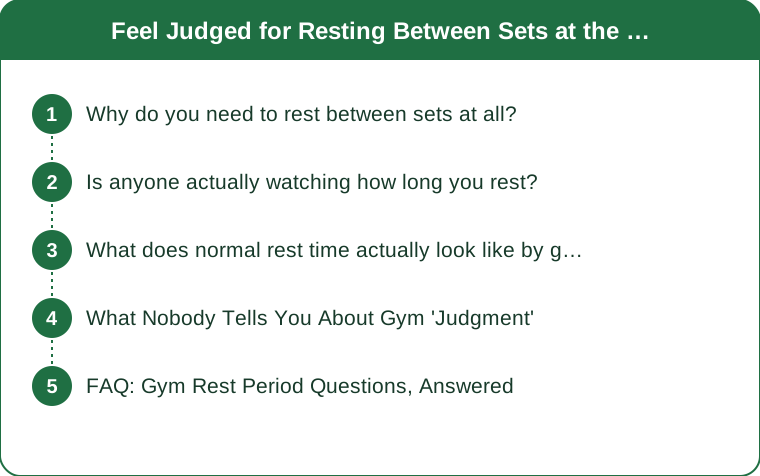
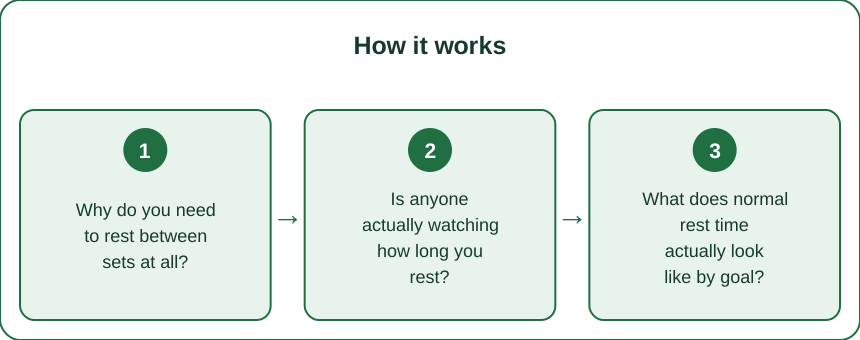
Why do you need to rest between sets at all?
Your muscles use a fuel system (ATP-PC) that regenerates in roughly 2-3 minutes for heavy lifts and 60-90 seconds for moderate ones. Cut that short and your next set isn’t a real set — it’s a weaker, sloppier version that doesn’t build the strength or muscle you’re there for.
Rest isn’t a break from training. It’s a required part of the training.
Is anyone actually watching how long you rest?
Almost never, and here’s why: most gym-goers are deep in their own internal narrative — their next set, their form, their own imagined audience. Studies on self-focus (sometimes called the spotlight effect) consistently show people wildly overestimate how much others notice them, in gyms and everywhere else.
The person on the bench next to you is thinking about their own rest timer, not yours.

What does normal rest time actually look like by goal?
- Heavy strength work (1-5 reps): 2-3 minutes, sometimes up to 5 for very heavy compound lifts
- Hypertrophy/muscle building (6-12 reps): 60-90 seconds
- Endurance/light work (12+ reps): 30-60 seconds
Sitting on a bench checking a phone timer for 90 seconds isn’t slacking — it’s precisely the protocol that gets you stronger over time.
What Nobody Tells You About Gym ‘Judgment’
The people you’re most worried about judging you are often doing the exact same thing — sitting, scrolling, staring at a wall — during their own rest periods. If you actually watch a busy gym for 10 minutes, you’ll see rest periods everywhere; they’re just invisible to you because you’re focused on your own set, the same way others are focused on theirs.
The anxiety is rarely about actual observation — it’s the spotlight effect working exactly as it’s designed to.
FAQ: Gym Rest Period Questions, Answered
How do I stop feeling anxious during rest periods?
Give yourself a job — set a phone timer and look at it, review your next set’s weight, or note your reps. Having a visible task makes the rest read as purposeful, both to you and anyone glancing over.
Is it rude to sit on equipment during rest if the gym is busy?
If you’re using it for your working sets, no — that’s normal use. If a piece is in high demand, doing supersets (alternating exercises) or offering to work in with someone during long rests is a considerate middle ground.
Does resting longer mean I’m out of shape?
No — rest needs are based on the load and rep range you’re using, not your fitness level. Advanced lifters doing heavy strength work often rest longer than beginners doing lighter work.
TL;DR:
- Rest periods (60 seconds to 3+ minutes depending on goal) are required, not optional
- Most people at the gym are absorbed in their own workout, not watching yours
- The spotlight effect explains why judgment feels real even when it almost never is
- Giving yourself a visible task during rest (timer, notes) reduces the self-consciousness
See It in Motion
Seen here: Super High Waist Embossed Yoga Leggings with Inner Pocket — shop it on bubblelime.com
Keep Reading
This article is for general informational and styling purposes only. Fit, sizing, and product availability may vary.