Free Weight Area Anxiety Is Mostly About One Specific Fear, Not General Gym Intimidation
Quick Answer: It isn’t general gym anxiety — you’re fine on the machines. The specific fear is being watched while visibly doing something wrong. Machines hide that risk because their fixed path limits how wrong you can look; free weights don’t hide anything. The fix follows directly: rehearse three or four fundamental lifts somewhere low-visibility first, book one session focused specifically on free weight technique, and notice that the people you’re afraid of are counting their own reps.
You walk into the gym perfectly fine. Cardio floor, fine. Machines, fine.
Then you look at the rack area and something in you says not today and you do leg press instead. Again.
That’s not general intimidation. General intimidation would have stopped you at the door.

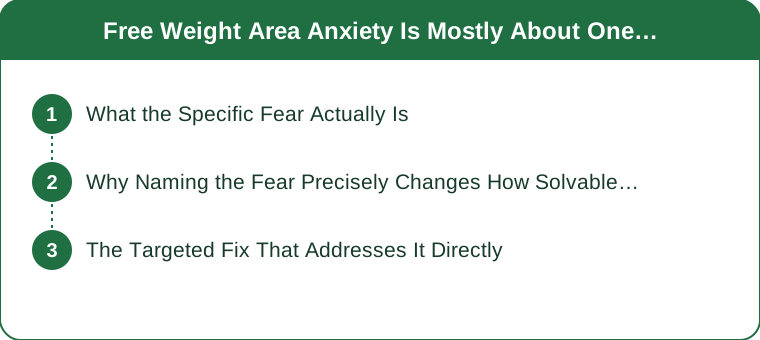
What Is the Actual Fear?
Being watched while visibly doing something wrong. Not being watched — that happens everywhere in a gym, including the treadmill you’re comfortable on. The specific dread is performing an unfamiliar movement incorrectly in a way that’s obvious to anyone looking.
Machines hide your mistakes; free weights don’t. This is the mechanical difference, and it explains why the anxiety is so precisely located. A machine constrains the movement path — there’s a limited range of ways you can look wrong on a lat pulldown, because the machine won’t let you do most of them. A barbell will happily let you do anything, including things that look alarming. The error isn’t just possible; it’s visible.
The perceived crowd amplifies it. The free weight section is often read — accurately or not — as populated by people who obviously know what they’re doing. That raises the stakes on a visible mistake in a way the machine area, which feels lower-stakes, simply doesn’t.

Why Does Naming It This Precisely Matter?
Because vague fears feel like personality traits and specific fears feel like problems.
“I have gym anxiety” is unsolvable-sounding. It reads as a fixed characteristic. What’s the fix? Be a more confident person? That’s not an action.
“I’m afraid of being watched doing a deadlift wrong” has an obvious countermeasure. Learn the deadlift somewhere nobody’s watching. The fear names its own solution the moment you state it accurately.
And the misdiagnosis leads to useless advice. If you treat it as general intimidation, you get general confidence-building suggestions — affirmations, going with a friend, “nobody cares about you.” Some of that helps a little. None of it targets a technique-visibility fear, because that’s not what it was aimed at. You end up applying a broad remedy to a narrow problem and concluding you’re just anxious.
The diagnostic step is genuinely half the fix here.
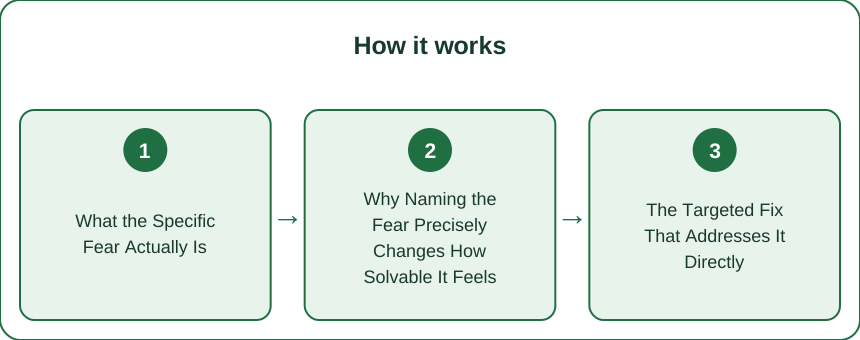
What Actually Fixes It?
1. Rehearse the movements somewhere low-visibility first. Pick four fundamentals — goblet squat, dumbbell Romanian deadlift, dumbbell bench or floor press, dumbbell row. Learn them at home with a single dumbbell, or in an empty studio room at your gym, or with a trainer in a private session. Do this for two or three weeks. You’re not building strength; you’re removing the actual likelihood of a visibly obvious mistake before you ever walk over there. The fear is partly rational — it goes down when the underlying risk goes down.
2. Book one session on free weight technique specifically. Not “personal training” in general — a session where you say: teach me the squat, the hinge, the press, and the row, and tell me what I’m doing wrong. One to three sessions covers it for most people. This targets the actual fear, which is about competence in visible technique, rather than confidence in the abstract.
3. Examine the premise. The fear assumes experienced lifters are watching and evaluating your form. Spend one session actually observing: they’re counting reps, checking their phone between sets, staring into the middle distance, and thinking about their own next set. People genuinely focused on their own training are not running quality control on yours. The fear isn’t irrational — it’s just built on a factual claim about other people’s attention that mostly isn’t true.
A practical fourth: go at a quiet hour for your first few sessions. Mid-morning on a weekday, or late evening. Reducing the audience while you’re building the competence isn’t avoidance — it’s a reasonable ramp.
Mini FAQ
Will anyone actually say something if my form is off?
Occasionally someone offers a correction. In most gyms it’s well-intentioned, and it’s rarer than the fear suggests. If it happens, “thanks, I’m working on it” ends the interaction completely.
How long until the free weight area stops feeling like that?
For most people, four to six sessions in the space. Familiarity does most of the work — the fear is largely about novelty, and novelty has a short shelf life.
What if I genuinely can’t afford a trainer?
Film yourself from the side with your phone and compare against a reputable coaching video. It’s slower than a trainer and it works. Most form errors on fundamental lifts are obvious on video and invisible from the inside.
TL;DR:
- The fear is specific: being watched while visibly doing something wrong — not being watched generally.
- Machines constrain the movement path and hide errors; free weights expose them.
- Naming it precisely converts an unsolvable-feeling trait into an addressable problem.
- Fix: rehearse 4 fundamentals privately, book 1–3 technique-focused sessions, and check the premise.
- Go at a quiet hour while you build competence. Expect it to fade in 4–6 sessions.
See It in Motion
Seen here: Yoga Jogger Sweatpants with Pockets — shop it on bubblelime.com
Keep Reading
This article is for general informational and styling purposes only. Fit, sizing, and product availability may vary.