Training With Someone Fitter Than You: Questions Answered
Quick Answer: Training with someone fitter works when you share the session but not the numbers - same exercises, same rest periods, different weights and different intensities. It fails when you try to match them, which produces either injury or the quiet demoralisation that ends the arrangement in three weeks. The two conversations to have on day one: what each of you is actually training for, and an explicit agreement that you will not be doing the same loads. Said out loud once, it stops being awkward. Left unsaid, it becomes the whole dynamic.
Most of the questions below are really one question - how do I do this without feeling bad - and the answers are more practical than psychological.

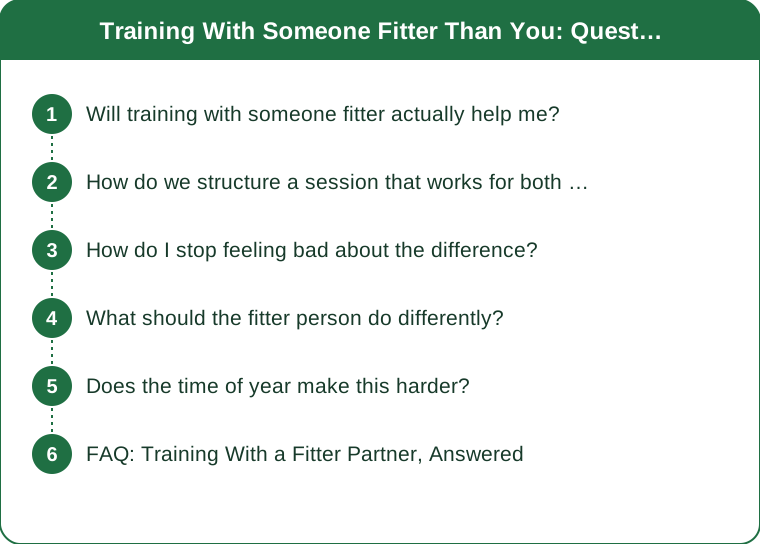
Will training with someone fitter actually help me?
Usually yes, and for reasons that are not about the workouts themselves.
What is the actual benefit?
Attendance. By a distance. The strongest predictor of results in the first year is how often you turn up, and having someone expecting you is the most reliable attendance mechanism there is. Everything else is secondary to that.
Do I actually learn from them?
Often, yes - equipment familiarity, gym norms, and the general confidence of walking into a free weight area with someone who obviously belongs there. A lot of gym anxiety is about not knowing the unwritten rules, and a fitter friend is a shortcut through all of it.
Will I progress faster?
Possibly, through a modest effort effect - most people work slightly harder with company. But you can also progress slower if you are constantly doing their programme instead of one suited to you.
When does it not work?
When the fitness gap is so large that no session suits both of you, when their goal is completely different from yours, or when either of you is competitive about it. The last one is the killer and it is worth being honest with yourself about.
How do we structure a session that works for both of us?
Three formats, in order of how well they handle a gap.
What is the simplest approach?
Same exercises, different numbers. You both squat, you both bench, you both do the accessory work. The weights on the bar are different and that is the entire adjustment. This works for almost any gap and it is the default.
What about supersets and circuits?
Excellent for mismatched pairs, because you are working at the same time rather than watching each other. Set a work interval rather than a rep count and each of you does what you can in it. The interval is shared, the output is not.
Should we do the same programme?
Only if your goals genuinely align. A person training for a marathon and a person trying to build strength should not be running the same session regardless of fitness level. Different goals is a bigger problem than different levels.
What is the best format if the gap is very large?
Train in parallel rather than together. Same time, same gym, separate programmes, meeting for the warm-up and the walk home. You keep the entire attendance benefit and remove the mismatch problem completely. This is underrated and it is what most long-running gym partnerships eventually become.
How do I stop feeling bad about the difference?
Practical answers, because the reassurance version does not work.
Should I just try to keep up?
No, and this is the single most important answer here. Matching someone else’s load is the most common route to injury in a mismatched pair - you are asking your tissue to handle a stimulus it has not been prepared for. It is also the fastest way to hate the arrangement.
How do I track progress without comparing?
Compare yourself to yourself, in writing. Keep a log of your own numbers and look at the eight-week trend rather than at the person next to you. Beginners progress faster in percentage terms than experienced lifters - your rate of improvement is very likely higher than theirs, even though your absolute numbers are lower.
Is it worth saying something?
Once, early, plainly. Something like: I am not going to be lifting what you lift and that is fine, let us just train at the same time. Naming it removes it as an undercurrent and almost everyone responds well.
What if they keep pushing me to add weight?
Say no clearly rather than deflecting. A good training partner will adjust immediately. One who does not, after being told, is not a good training partner - and that is information about them rather than about you.

What should the fitter person do differently?
Worth reading whichever side you are on, because both people can wreck this.
Should they modify their own training?
Not substantially, no. Resentment builds fast if one person is permanently training below their level, and the arrangement does not survive it. Shared structure, individual intensity.
How should they handle form corrections?
Sparingly, and only when asked or when something is genuinely unsafe. Unsolicited coaching is the fastest way to make someone feel like a project rather than a training partner. One clear comment about a dangerous position is welcome; a running commentary is not.
What actually helps?
Handling the logistics. Setting up the equipment, knowing which machine is free, loading and stripping the bar. Small things that remove friction for a newer person.
What is the most useful thing they can say?
Something about their own early days, honestly. Everyone who is fit now was once not, and hearing the specifics of that is more useful than encouragement.
Is it a burden on them?
Usually far less than the newer person assumes. Most people enjoy training with company and are not evaluating your numbers - they are thinking about their own set, exactly as you are.
Does the time of year make this harder?
It does, and right now specifically.
Why does autumn change the dynamic?
Gyms get significantly busier from September. Outdoor training moves indoors, term restarts, and the new-year rush has a smaller autumn sibling. Busy gyms make a mismatched pair harder to manage because you end up sharing equipment, which forces you into the same weights and the same timings.
How do we handle a busy gym?
Work in properly - agreed rest periods, and change the pins or plates between you without discussion. Or split up during peak hours and meet at the end. Fighting for equipment as a pair is worse than training separately.
Are there better times to go?
Early morning and mid-afternoon are consistently quieter. If you can move your shared session out of the 5-8pm window, most of the equipment problems disappear.
Does anything else change?
Motivation, honestly. Dark evenings are when training partnerships prove their value - the arrangement that felt optional in July is the reason you go in November. This is the season where the attendance benefit pays for everything else.
Is now a good time to start one?
Good, yes - establishing the habit in September means it is embedded before the hardest months. Starting in January means starting alongside everyone else, in the busiest possible gym.
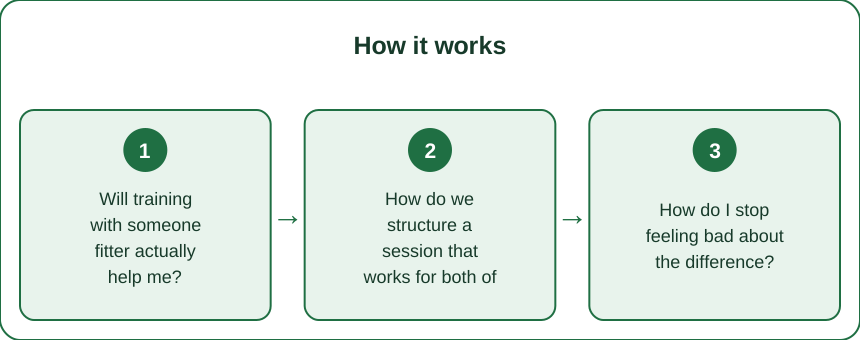
FAQ: Training With a Fitter Partner, Answered
What if they get bored training with me?
Ask rather than assume. Most of this worry is invented, and if it turns out to be true, parallel training solves it without ending anything.
Should I get my own programme?
Yes. Following someone else’s programme is the most common mistake here - it was written for their level, their goals, and their recovery capacity. A basic beginner programme done properly beats an advanced one done partially.
Is it better to train with someone at my level?
Different benefits. A similar-level partner gives you shared struggle; a fitter one gives you confidence and know-how. Neither is better, and many people benefit from one of each.
What about group classes instead?
A good middle ground - everyone works at their own level by design, and nobody is watching anybody. A class is often the easiest way to train alongside a fitter friend without the mismatch being visible at all.
How long before the gap narrows?
Meaningfully within six to twelve months if you are newer, because beginner progress is fast. It rarely closes entirely, and it does not need to. This is general information, not medical advice - if you are returning from injury, get individual guidance before matching anyone’s programme.
TL;DR:
- Share the session, not the numbers. Same exercises, same rest, different loads - that is the whole adjustment.
- The real benefit is attendance, and it is the biggest predictor of results in your first year.
- Say it out loud once on day one, and it stops being an undercurrent.
- Never try to match their weights. It is the most common route to injury and to quitting.
- The fitter partner should handle logistics and keep form advice to what is genuinely unsafe.
- Autumn gyms get busy - train in properly or split during peak hours, and consider parallel training.
The version of this that lasts for years is almost always two people who arrive together, train separately, and leave together. That sounds like a compromise and it is actually the design.
See It in Motion
Seen here: High Waist Jogger Sweatpants with Pockets — shop it on bubblelime.com
Keep Reading
This article is for general informational and styling purposes only. Fit, sizing, and product availability may vary.