What Changes in the Gym at the End of August?
Quick Answer: Gyms change measurably in the last week of August. Attendance rises sharply as schedules resume and the summer-vacation dip ends - the September surge starts before September. The mix of people changes, with more new members than at any point since January. And the equipment competition shifts toward machines and cardio as newer members arrive. None of that has anything to do with you, but it changes the practical experience of training - and knowing the pattern in advance is most of what makes it manageable.
You had a great summer of training in an empty gym. You walk in the last week of August and there is a line for everything.
This is entirely predictable, and it is worth planning for rather than reacting to.

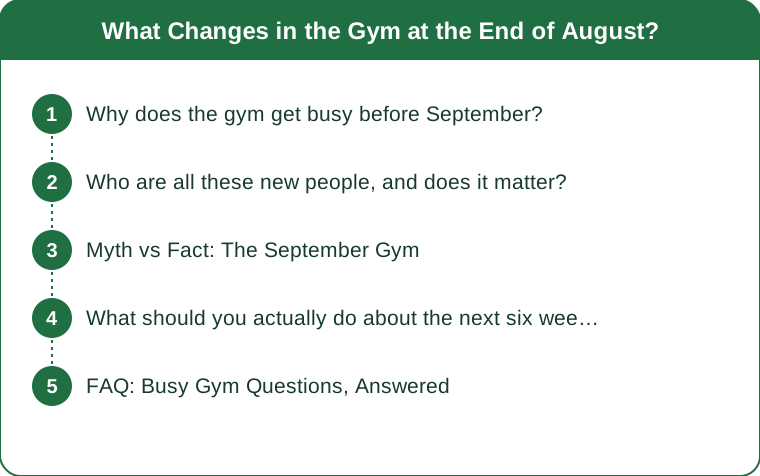
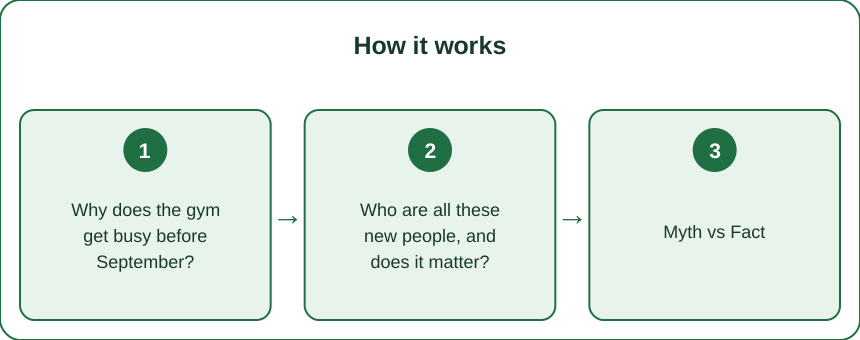
Why does the gym get busy before September?
Because attendance tracks schedules, and schedules restart in August.
Gym attendance follows a well-documented annual pattern: a January peak, a spring decline, a summer trough, and a September recovery that begins in the last two weeks of August as school terms and work schedules resume.
The summer trough is largely about vacations and about people training outdoors. Both end at the same time, and the return is concentrated into a narrow window.
The practical effect is that a gym that was comfortable at 6pm in July is genuinely crowded at 6pm in the last week of August, and will stay that way through October before settling.
The times that get worst are 6 to 8am and 5 to 7pm, which are the hours tied to the schedules that just resumed. Midday and late evening stay relatively unchanged, which is the single most useful piece of information here.
If your schedule allows any flexibility, moving your session by 90 minutes is worth more than any other adjustment - a 4:30pm or an 8pm session in September is close to a July experience, and a 6pm session is not.
Who are all these new people, and does it matter?
More new members arrive in late August and September than at any time except January - and the honest answer is that it matters mostly in a good way.
The common anxiety is being watched by experienced people. The actual composition in September is heavily weighted toward people who are new, uncertain, and entirely focused on their own session. The room is less expert, not more.
There is a well-replicated psychological phenomenon at work in the anxiety itself. People consistently and dramatically overestimate how much others notice them - it has been demonstrated repeatedly in controlled settings, and gyms are one of the environments where it operates most strongly.
What does change practically: equipment gets held longer because newer members are less familiar with efficient use of rest time, and etiquette is less established, so weights get left out and machines get sat on between sets.
None of that requires confrontation. Working in is a normal and expected request, and the phrase that works is simply asking how many sets someone has left and whether you can work in. Most people say yes immediately.
And it is worth remembering the other direction: you were new once, and the September crowd contains a lot of people who would find a small piece of friendliness genuinely valuable. That is a much better frame for a busy gym than resentment.

Myth vs Fact: The September Gym
Myth: The crowds last until January. Fact: The September surge peaks in mid to late September and declines noticeably through October and November. Attrition among new members is high - most of the people who make a busy week in September are not there in December. This is not a reason to be dismissive of them; it is a reason not to reorganize your entire training year around a six-week period.
Myth: I need to change my program because equipment is unavailable. Fact: You need one or two substitutions, not a new program. A dumbbell version, a machine version and a bodyweight version of each of your main lifts covers essentially every availability scenario, and having them planned in advance means you never lose a session to a busy rack.
Myth: Everyone is judging my form. Fact: Attention in a gym is overwhelmingly self-directed - people are watching themselves in mirrors, tracking their own sets, and thinking about their own next lift. The spotlight effect is well documented and it consistently exaggerates how visible we feel.
Myth: Peak hours are the only time serious people train. Fact: This is entirely a scheduling artifact. Peak hours are peak because of work and school, not because of anything about training. The 2pm crowd is not less committed - it is differently employed.
What should you actually do about the next six weeks?
Three practical adjustments and one mental one.
Shift your time if you possibly can. 90 minutes either side of the 5-to-7pm window is a completely different gym. If your schedule genuinely will not move, go earlier rather than later - the morning crowd clears more predictably than the evening one.
Have substitutions planned before you arrive. For each main lift, know the dumbbell version, the machine version and the bodyweight version. Write them into your program now, not while standing in a busy gym feeling flustered. This one change removes most of the frustration.
Restructure to supersets and circuits during peak weeks. Pairing two exercises that use different equipment - or an exercise and a bodyweight movement - halves your equipment footprint and gets you out faster. It is also a perfectly good way to train, not a compromise.
And reframe the crowd. A busy gym in September is a room full of people who decided to start something, most of whom are nervous, most of whom will not still be there in December - and some of whom will, because it went well. You are one of the people who makes that room feel possible or not, just by being unbothered and getting on with your work.
That is genuinely the most useful thing you can do with the next six weeks, and it costs nothing.
FAQ: Busy Gym Questions, Answered
How do I ask to work in without it being awkward?
Wait until they finish a set, then ask how many they have left and whether you can work in. Both parts matter - the first shows you are not rushing them, the second is a clear request. Almost everyone says yes, and the ones who do not usually have a reason. If you find it hard, the useful thing to know is that the awkwardness is entirely in the anticipation and essentially never in the interaction.
What if someone is using equipment wrong and might hurt themselves?
Unsolicited form advice is generally unwelcome and frequently wrong, and it is one of the main things that makes new members feel unwelcome. The exception is genuine immediate danger - a collar not clipped, a bar about to roll. Say something brief and specific about the safety issue and nothing about their technique.
Is it worth switching to a different gym for a few weeks?
Usually not - most gyms have the same seasonal pattern, so you are trading a familiar busy gym for an unfamiliar one. Changing your time of day is a far more effective adjustment and costs nothing.
TL;DR:
- The September surge starts in the last week of August, when school and work schedules resume.
- 6 to 8am and 5 to 7pm get crowded; midday and late evening barely change.
- Shifting your session by 90 minutes is worth more than any other adjustment.
- Plan dumbbell, machine and bodyweight substitutions for each main lift before you arrive.
- Supersets halve your equipment footprint during peak weeks and are good training anyway.
- The room is full of new people who are nervous, not experts who are watching - and the crowd thins by November.
The gym in September is a room full of people who decided to start. Being unbothered and getting on with your work is the most useful thing in it.
See It in Motion
Seen here: Racerback Tank Top - White — shop similar styles on bubblelime.com
Keep Reading
This article is for general informational and styling purposes only. Fit, sizing, and product availability may vary.