What to Do When Someone Corrects Your Form Uninvited
Quick Answer: You are not obliged to accept, discuss or act on advice you did not ask for. A short, neutral response - thanks, I am following a programme - ends most interactions cleanly and without conflict. Some unsolicited advice is genuinely well-meant and occasionally correct, so it is worth noting what was said and checking it later rather than either adopting it on the spot or dismissing it. If it continues after you have declined, or feels like something other than coaching, that is a staff matter.
You were mid-set. Someone appeared.
You do not owe them a conversation, and you also do not have to make a scene.
There is a middle response, and it is short.

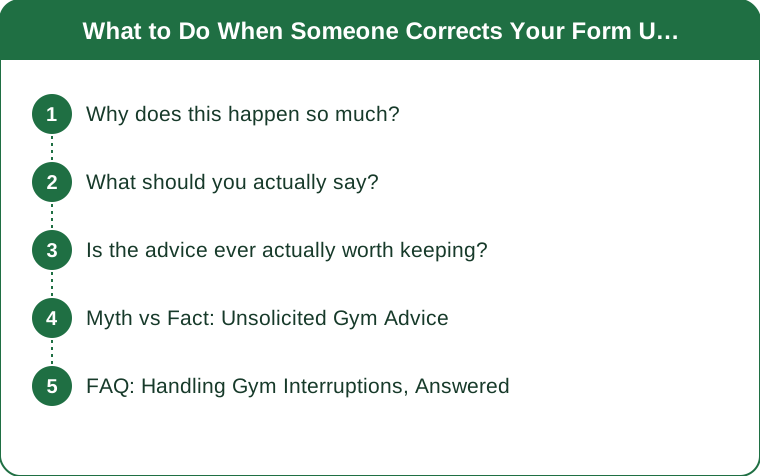
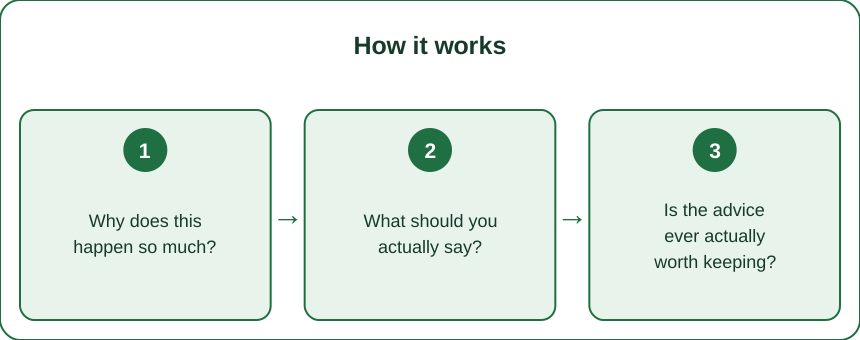
Why does this happen so much?
Several different motivations that look identical from the outside.
Genuine concern, usually about safety. Some people see something they read as risky and feel obliged to say something. They are often wrong about the risk and their intent is what they say it is.
The urge to demonstrate expertise. Common in people who have recently learned something and want to use it. This is where most of the confidently incorrect advice comes from - the correction is about the giver, not about you.
Gym culture in some spaces genuinely normalises it. In powerlifting and weightlifting gyms, unsolicited coaching between lifters is often a real and welcome norm. In a commercial gym it usually is not. Some people carry the norm from one setting to another.
And a pattern worth naming plainly: women report receiving unsolicited advice at the gym considerably more often than men do, particularly in free weight areas, and frequently from people with no more experience than they have. If it feels like it happens to you more than it should, that perception is well supported.
Occasionally it is not about lifting at all. An approach that starts with form advice and continues into conversation after you have disengaged is a different interaction, and it is reasonable to treat it as one.
Why the distinction matters practically: you cannot reliably tell which category you are in during the first five seconds. Which is why the best default response works regardless - it is polite enough for genuine concern and final enough for everything else.
What should you actually say?
Something short, neutral and closed. Length invites continuation.
The reliable defaults:
- Thanks, I am following a programme. Ends it cleanly, implies you have a plan, invites nothing
- Thanks, I have got it. Shorter, entirely sufficient
- I am fine, thanks. With a return to what you were doing
- Thanks, I will look into that. If the advice sounded plausible and you want to check later
What makes these work is that they are complete. A response that explains, justifies or asks a question opens a conversation. Thanks and a return to your set does not.
Physical signals do as much work as words:
- Put a headphone back in after responding
- Turn back toward the equipment
- Start your next set
- Do not maintain eye contact past the response
None of this is rude. You are declining a service you did not request, briefly and politely.
If it continues after a clear response:
- Repeat the same phrase. Do not escalate or elaborate - repetition without new information is the most effective de-escalation available
- I would rather train on my own, thanks. Direct, still polite
- Move to a different piece of equipment if that is easier than continuing
- Speak to staff if someone will not leave you alone. This is exactly what gym staff are there for and using them is not an overreaction
Two things not to do: do not get into a technical debate, which extends the interaction and rarely changes anyone’s mind, and do not apologise. You have nothing to apologise for and it signals that the interaction is negotiable.
And if you are genuinely unsure whether they had a point, the answer is not to work it out standing there. Note it, finish your session, check it afterwards.

Is the advice ever actually worth keeping?
Sometimes. The way to handle that is to check it later, not to evaluate it mid-set.
Some unsolicited corrections are correct. Rounding under a heavy deadlift, a knee collapsing inward under load, an unsafe setup on a squat rack - these are real, and someone pointing them out may be doing you a favour regardless of how they did it.
A rough filter for what deserves checking later:
- Advice about safety and setup - collar clips, rack height, spotter arms - is usually worth taking seriously immediately
- Advice about a specific joint position under heavy load is worth checking
- Advice about tempo, breathing or bracing is often reasonable and rarely urgent
- Advice that this exercise is bad or you should do a different one instead is almost never useful and usually reflects a preference, not a principle
- Advice contradicting a programme you are following should lose to the programme until you have reason to think otherwise
How to actually check it:
- Film a set from the side. This is the single most useful habit in the gym and settles almost every technique question definitively
- Compare against a reputable coaching source for that specific lift
- Ask a coach or a trainer at the gym if you have access to one
- Post the clip in a knowledgeable community if you do not
Filming also changes the dynamic in a useful way. Watching your own set from the outside builds the ability to self-assess, which reduces how much any individual opinion matters.
And the broader point: having a programme you trust removes most of the emotional weight from this. When you know what you are doing and why, an interruption is a minor inconvenience rather than a source of doubt. The people who find these encounters most destabilising are usually the ones who are not sure whether they belong there - and the fix for that is competence and a plan, both of which are entirely achievable.
Myth vs Fact: Unsolicited Gym Advice
Myth: If you decline, you are being rude. Fact: You are declining a service you did not request. A polite thanks and a return to your set is a complete and appropriate response. The person who approached mid-set is the one who chose to interrupt.
Myth: They must know more than you if they are confident. Fact: Confidence and competence correlate poorly, and people who have recently learned something are among the most likely to offer it unprompted. Assess the content later; do not assign authority in the moment.
Myth: You should explain your programme so they understand. Fact: Explaining extends the interaction and invites debate. Thanks, I am following a programme is enough. You do not owe anyone a justification for how you train.
Myth: Involving staff is an overreaction. Fact: Managing member conduct is part of what gym staff do. If someone will not accept a clear no, telling staff is the proportionate response, and it is far better than changing your training time to avoid one person.
Myth: It happens to everyone equally. Fact: Women report unsolicited advice at the gym substantially more often, particularly in free weight areas. If it feels disproportionate, that impression is well supported and you are not imagining it.
Myth: Ignoring it entirely is the best approach. Fact: Silence sometimes invites a second attempt because it reads as uncertainty. A brief clear response plus a return to your set closes it more reliably than saying nothing at all.
FAQ: Handling Gym Interruptions, Answered
What is the best thing to say?
Thanks, I am following a programme. It is polite, complete, implies you have a plan, and does not open a conversation. Then turn back to the equipment and start your next set - the physical signal matters as much as the words.
What if they keep going?
Repeat the same phrase without adding anything new. Repetition without new information is the most effective de-escalation there is. If it continues past that, move to different equipment or speak to staff, which is exactly what they are there for.
How do I know if the advice was actually correct?
Do not try to work it out mid-set. Note what was said, film a set from the side afterwards, and compare against a reputable coaching source or ask a trainer. Filming is the single most useful technique habit in the gym.
Should I say thank you if the advice was wrong?
A brief thanks costs nothing and ends the interaction faster than a correction would. You are not endorsing the advice by being polite, and a technical debate mid-session helps nobody.
Is it different in a powerlifting gym?
Often yes - in some strength-focused gyms, coaching between lifters is a genuine and welcome norm. Even there you can decline, and the same short response works. Context changes the intent, not your right to say no thanks.
What if it feels like more than gym advice?
If someone continues a conversation after you have clearly disengaged, treat it as what it is rather than as coaching. Tell staff. You do not need to justify the request or be certain about their intent to ask for it to stop.
TL;DR:
- You are not obliged to accept, discuss or act on advice you did not ask for
- Thanks, I am following a programme - short, polite, complete, and invites nothing further
- Turn back to the equipment and start your set; the physical signal closes it as much as the words
- Do not explain, debate or apologise - all three extend the interaction
- Repeat the same phrase if it continues; involve staff if it does not stop
- Some advice is correct - note it, film a set from the side later, and check it properly
- Safety and setup advice is worth taking seriously; you should do a different exercise usually is not
Having a programme you trust takes most of the sting out of the whole thing.
See It in Motion
Seen here: Super High Waist Embossed Yoga Leggings with Inner Pocket — shop it on bubblelime.com
Keep Reading
This article is for general informational and styling purposes only. Fit, sizing, and product availability may vary.