What To Do When You Set Up on the Wrong Equipment: Your Questions, Answered
Quick Answer: Say one short sentence — “Sorry, I didn’t realise, it’s yours” — then move. Do not over-explain, do not offer a long apology, and do not stand there deciding. Almost everyone has done exactly this, and the awkwardness lasts about four seconds unless you extend it.
The reason it feels enormous is that you are the only person in the room replaying it.

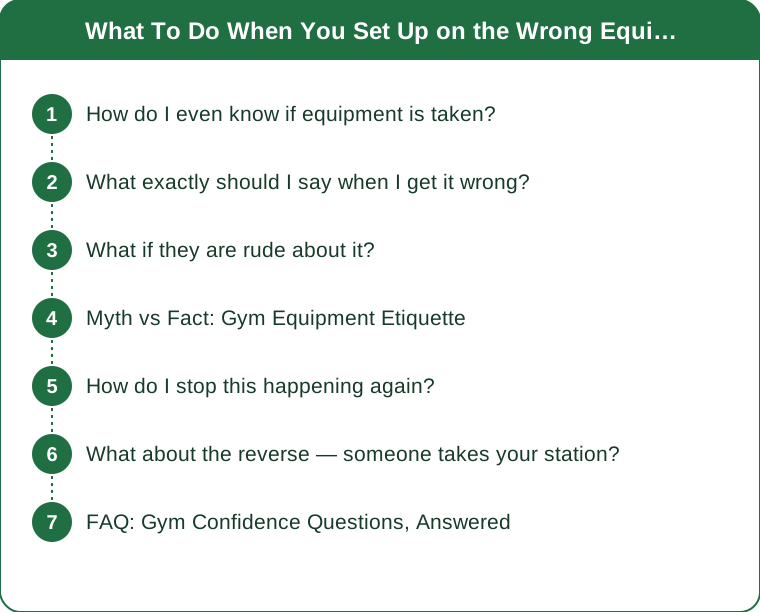
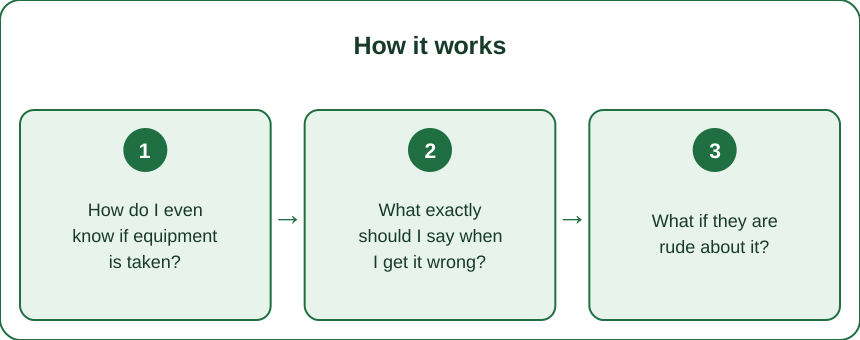
How do I even know if equipment is taken?
The signals are unreliable, which is why this happens constantly. A towel, a water bottle, a phone, or a loaded bar all sometimes mean occupied and sometimes mean abandoned twenty minutes ago.
The rule of thumb is roughly two minutes. If nobody has come back to it in that time and nothing is on it, most gyms treat it as free. Longer than that with no owner in sight and you can reasonably start.
Look for the superset pattern. Someone alternating between a bench and a cable station may be five metres away and still using both. Scanning for a person who keeps glancing at the station is more reliable than looking for objects.
When in doubt, ask the nearest person. “Is anyone on this?” is four words and removes the entire problem.
What exactly should I say when I get it wrong?
Short, plain, and then leave. “Sorry — all yours.” That is enough and it is what experienced gym-goers say.
Avoid the long apology. Extended apologising makes the other person manage your discomfort, which is the thing that actually creates an awkward moment.
Do not explain your reasoning. Nobody needs to know that you waited, that the towel confused you, or that you assumed. It reads as defensiveness even when it is not.
If you have already loaded plates, strip them back to where you found it, or ask: “Do you want these off?” Leaving someone a bar loaded with your weights is the part that genuinely annoys people.
What if they are rude about it?
Occasionally someone will be, and it is about them. A short, neutral response — “No problem” — and moving on gives them nothing to escalate.
Do not match the tone. Gym confrontations almost always look worse for whoever continues them, and no one else in the room is tracking who started it.
Report genuine aggression to staff. Rudeness is not worth reporting; intimidation, shouting, or physical behaviour is, and staff would rather know.
And keep it in proportion. One unpleasant person does not tell you anything about the gym or about whether you belong in it.

Myth vs Fact: Gym Equipment Etiquette
Myth: Everyone notices when you make a mistake. Fact: Most people in a gym are counting reps, watching a timer, or looking at their phone. Bystander recall of other people’s minor errors is close to zero.
Myth: A towel reserves a station indefinitely. Fact: In most gyms it holds for a few minutes. Leaving a towel on a bench while doing twenty minutes of cardio is the actual etiquette breach.
Myth: You should never interrupt someone to ask about equipment. Fact: Asking between sets is normal and welcome. Asking mid-set is the thing to avoid.
Myth: Working in is rude. Fact: It is standard practice, particularly at peak hours. “Mind if I work in?” is a completely ordinary sentence.
Myth: Experienced lifters never do this. Fact: They do it more often, because they use more stations per session and superset more.
How do I stop this happening again?
Plan a backup for each exercise before you start. If the rack is busy, you already know you are doing goblet squats instead, so there is no decision to make in the moment.
Train at consistent times. Within two weeks you will know which stations are contested at that hour and can sequence around them.
Say your intention out loud early. “I’ve got two sets left, then it’s free” prevents half of these situations before they start.
Accept a certain rate of it. In a busy gym this will happen a few times a year no matter what you do. The skill is the four-second recovery, not prevention.
What about the reverse — someone takes your station?
Say it early and say it plainly. “Sorry, I’ve got two sets left on this” is the whole script. Said within a few seconds it is a non-event; said after two minutes of internal debate it feels like a confrontation.
Offer to work in. It resolves almost every version of this immediately and costs you very little.
Do not silently wait. Standing nearby hoping to be noticed is the option that produces resentment, and it is the one most people choose.
If they have already started a set, let them finish. Interrupting mid-set is the one genuine etiquette breach in this whole situation.
And if you would rather not say anything at all, move on to your backup exercise. Choosing not to have the conversation is a legitimate option, as long as it is a choice rather than a default.
FAQ: Gym Confidence Questions, Answered
How long can I sit on a machine between sets?
Up to about 90 seconds is normal for strength work. Beyond two or three minutes at a busy time, offer to let someone work in rather than holding the station.
Should I re-rack someone else’s weights if they left them?
If you want the equipment, yes, and without commentary. It is faster than finding them and it is what most people do.
Does this get easier?
Measurably. Most of the anxiety is uncertainty about the script, and once you have a one-sentence response ready, the situation stops registering as an event.
Is it worse at busy times of year?
Yes, predictably. Early September brings a large intake of new members, so stations are contested more and these situations happen more often for a few weeks. Everyone in the building is dealing with the same thing.
Should I apologise to staff if equipment gets damaged?
Tell them straight away and without elaborate apology. Staff care about the equipment being fixed and about nobody getting hurt; they do not need the story.
What if I genuinely do not know how something works?
Ask. “Have you used this one? I can’t work out the seat” is a normal question and most people enjoy answering it. Guessing on an unfamiliar machine is how people get hurt, and that is a much worse outcome than a moment of awkwardness.
TL;DR:
- One short sentence, then move. Long apologies create the awkwardness they try to fix.
- Two minutes with no owner is the rough threshold for treating a station as free.
- Strip your plates before handing a rack back — that is the part people actually mind.
- Asking “is anyone on this?” costs four words and prevents the whole scenario.
- Plan a backup exercise for busy stations so there is no decision to make in the moment.
Everyone has done this. The only people who remember it are the ones who did it.
See It in Motion
Seen here: Round Neck Long Sleeve Athletic T-Shirt — shop it on bubblelime.com
Keep Reading
This article is for general informational and styling purposes only. Fit, sizing, and product availability may vary.