Why Does the Gym Feel Harder to Walk Into in Autumn?
Quick Answer: Autumn stacks three things at once - the gym gets genuinely busier as summer outdoor training ends, you are likely returning after a less consistent summer, and darker evenings reduce motivation through a real physiological mechanism. Feeling worse about it is a reasonable response to changed conditions, not a personal failing. The practical fixes are timing, a shortened first session, and a fixed plan that removes decisions at the door.
The most useful single change: go at an off-peak hour for the first two weeks.

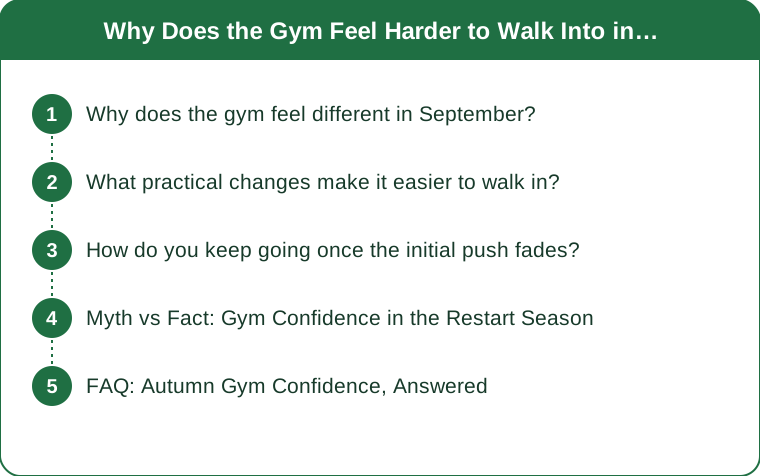
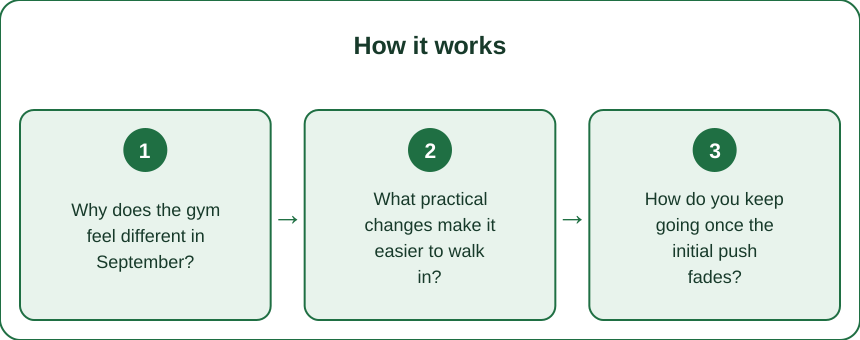
Why does the gym feel different in September?
Because several unrelated things converge in the same fortnight.
It is genuinely busier.
- People who trained outdoors all summer come back indoors
- The September restart effect brings a wave of new members, comparable in size to January in many gyms
- Peak hours compress as darker evenings push everyone into the same 5pm to 8pm window
- Which means more waiting, more sharing, and more people watching - all of which increase the perceived social cost of being there
You are probably less consistent than you were.
- Summer disrupts routines with holidays, different schedules, and lighter evenings spent elsewhere
- Returning after a gap is harder than continuing, and the fear of visible deconditioning is real
- You may genuinely be weaker, which is unpleasant to confront in a busy room
The daylight effect, which is physiological rather than attitudinal. Reduced light exposure affects mood and energy through measurable mechanisms. Evening motivation in particular drops sharply once it is dark at 6pm. This is not a discipline problem and treating it as one does not help.
The comparison problem specific to autumn. The gym in September is full of people mid-restart, many of whom are visibly enthusiastic. Arriving quietly to rebuild after a patchy summer, in a room of people apparently starting strong, is a particular kind of uncomfortable.
Worth knowing about the wave. The September surge subsides substantially within 4 to 6 weeks. If the crowding is the main problem, it is temporary - and knowing that changes how it feels.
What practical changes make it easier to walk in?
Timing, planning, and shortening the first sessions.
Timing, which is the highest-impact change:
- The quietest hours are typically 10am to 3pm on weekdays, and early mornings before 7am
- Avoid 5pm to 7pm for the first fortnight if you can. This is the single most crowded window of the year in September
- Weekend mornings after 11am are usually quieter than expected
- Ask at reception which hours are quietest. They know precisely and are almost never asked
Removing decisions at the door:
- Have the session written down before you arrive - exercises, sets, weights. Standing in a busy gym deciding what to do is where the discomfort concentrates
- Have a backup for every machine. Knowing what you will do if the leg press is taken removes the moment of standing around
- Know your route through the gym in advance, so you are moving purposefully rather than surveying
Shortening the return:
- Make the first session 20 minutes. The goal of session one is to have been, not to train hard
- Three or four exercises is plenty. The most common return mistake is a full session that leaves you too sore to come back for a week
- Start at roughly 60 to 70 percent of your pre-summer weights. You will be back within a few weeks, and starting light avoids the soreness that derails restarts
Managing the room:
- Headphones are a legitimate social boundary and universally understood in gyms
- The free weight area is intimidating in proportion to how unfamiliar it is. Walk through it once without training, just to remove the novelty
- Most people genuinely are not watching. The gym is full of people concerned about how they look, which is precisely why they are not looking at you
On asking for help. Staff would rather show you a machine than watch you use it wrong, and gym-goers asked a brief question almost always respond well. The perceived cost of asking is much higher than the actual cost - which is worth testing once, because the belief does not survive it.

How do you keep going once the initial push fades?
By reducing friction and lowering the bar, because willpower is not the variable that changed.
Why week three is where restarts die. The initial motivation is genuinely finite, and it typically fades around weeks 2 to 3, exactly as evenings get darker. Planning for this is more useful than expecting to feel motivated.
Friction reduction that works:
- Pack the bag the night before, always. The decision point in the morning is where sessions are lost
- Fix specific days and times rather than aiming for a number per week. A number gets negotiated; a slot in the calendar does not
- Choose the gym you pass anyway over the better one that requires a detour. Convenience predicts adherence better than facilities do
- Have a 20-minute minimum session you can do on bad days. Going and doing little beats not going
Adjusting expectations for the season:
- Autumn and winter are maintenance seasons. Roughly a third of your usual volume maintains fitness for months - a genuinely useful fact
- Two sessions a week consistently through winter beats four sessions for three weeks then nothing
- Some weeks will be bad. Planning three and doing two is a good week in November, and treating that as failure is how people stop
The daylight strategy:
- Morning or lunchtime sessions work better for most people through the dark months than fighting evening reluctance
- Get outdoor light early in the day where possible - it helps mood and sleep, both of which affect whether you train
- If evenings are the only option, go directly rather than home first. Once you sit down at home in the dark, the session is over
The tracking point. Write down what you did. In a season with little visible progress, a record of consistency is the thing that keeps you going - and after eight weeks, being able to see that you went 16 times is worth more than any individual session was.
Myth vs Fact: Gym Confidence in the Restart Season
Myth: Everyone there is judging you. Fact: The gym is disproportionately full of people worried about being judged themselves - which is precisely why almost nobody is watching. Most people are absorbed in their own set, their own phone, or their own discomfort.
Myth: You should not go back until you are fitter. Fact: This is the most self-defeating belief in the category, and it has no resolution. Everyone in the gym was once new, and most of them restarted more than once. The gym is where you get fitter, not the reward for already being so.
Myth: You need a full session or it does not count. Fact: Twenty minutes counts, and in the restart phase it counts more than an hour would. The goal of the first sessions is to establish that you go, not to generate training stimulus. Soreness that stops you returning is a net loss.
Myth: The September crowds mean you should wait until January. Fact: The surge subsides in 4 to 6 weeks, and January is worse. Off-peak hours in September are quieter than peak hours in any month. Waiting means missing a full quarter.
Myth: Asking for help marks you as a beginner. Fact: Experienced gym-goers ask each other things constantly, and staff prefer being asked to watching someone use a machine wrong. The perceived cost of asking is far higher than the real one - which you find out the first time you do it.
FAQ: Autumn Gym Confidence, Answered
When is the gym quietest in September?
Typically 10am to 3pm on weekdays and before 7am. Avoid 5pm to 7pm for the first couple of weeks - that window is the most crowded of the year. Reception staff know the exact pattern and are rarely asked.
How long does the September rush last?
Usually 4 to 6 weeks before numbers settle. If crowding is your main obstacle, it is genuinely temporary - and it is smaller and shorter than the January equivalent.
How hard should my first session back be?
Twenty minutes, three or four exercises, at roughly 60 to 70 percent of your previous weights. The aim is to establish attendance. Soreness bad enough to stop you returning for a week is the most common restart mistake.
What do I do if the machine I planned to use is taken?
Have a backup written down for each exercise. Standing around deciding is where discomfort concentrates. You can also ask to work in - it is normal and almost always fine.
Is it normal to feel more anxious about the gym in autumn?
Yes, and there are real reasons: it is busier, you are likely returning after a gap, and reduced daylight affects motivation and mood through measurable mechanisms. It is a response to changed conditions, not a character flaw.
How do I keep going when motivation runs out around week three?
Expect it, and plan for it. Pack your bag the night before, fix specific days rather than a weekly target, and keep a 20-minute minimum session for bad days. Consistency at low volume through winter beats intensity that stops.
TL;DR:
- Autumn stacks three things: a genuinely busier gym, a return after a patchy summer, and darker evenings
- Train off-peak for the first fortnight - 10am to 3pm or before 7am, and avoid 5pm to 7pm
- Write the session down in advance with a backup for every machine, so nothing is decided at the door
- Make the first session 20 minutes at 60 to 70 percent of previous weights
- Aim for maintenance, not progress - a third of your usual volume holds fitness for months
The September crowd thins in 4 to 6 weeks and almost nobody is watching you in the meantime. Show up short, show up often, and let week three be worse than week one without treating it as evidence of anything.
See It in Motion
Seen here: Super High Waist Embossed Yoga Leggings with Inner Pocket — shop it on bubblelime.com
Keep Reading
This article is for general informational and styling purposes only. Fit, sizing, and product availability may vary.