Why Does the Gym Feel More Intimidating When It Gets Busy in Autumn
Quick Answer: Gym attendance rises predictably in September and again in January, so the room is genuinely more crowded, equipment is genuinely less available, and the social pressure of waiting and sharing is genuinely higher. That is a real environmental change rather than a confidence regression. The practical responses are shifting your timing, having a flexible plan with substitutions ready, and knowing the specific scripts for asking to work in.
You had found your rhythm. You knew which machines were free at which times, and you had stopped rehearsing what to say to people. Then the first week of September arrived and the whole room refilled, and it feels like starting over - which is unfair, because you did not go backwards.
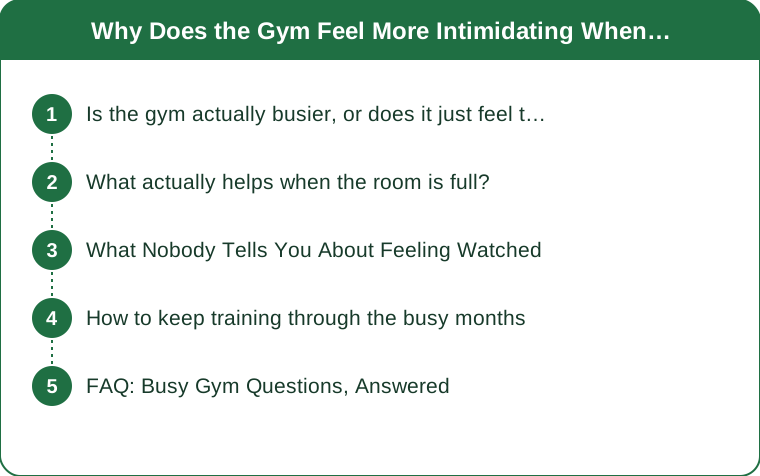
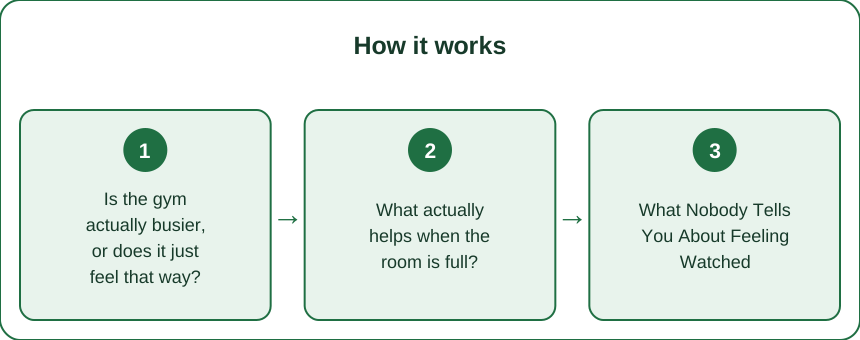
Is the gym actually busier, or does it just feel that way?
It is actually busier, and by a substantial margin.
Gym attendance follows a well-documented seasonal pattern. January is the largest surge, but September is a significant second peak, driven by the end of summer holidays, the return to routine, and the general back-to-school reset that affects adults as much as students.
The busy period lasts long enough to matter. The September rise typically holds through autumn rather than fading in a fortnight the way the January surge often does, because it is tied to a durable schedule change rather than a resolution.
Equipment availability changes disproportionately. A twenty percent increase in people does not produce a twenty percent increase in wait times - queuing effects mean congestion rises much faster than attendance once a facility approaches capacity. This is why the gym can feel dramatically busier from a modest increase in numbers.
Peak hours concentrate the effect. Early morning, lunchtime, and the after-work window absorb most of the increase, and the after-work window in particular becomes crowded as darker evenings push outdoor exercisers indoors.
And there are more genuinely new people, which changes the social atmosphere - more people unsure of etiquette, more equipment left unracked, more uncertainty about who is using what.
Why this matters for how you feel about it: attributing the discomfort to the environment rather than to yourself is both accurate and useful. A crowded room with unfamiliar faces is objectively harder to navigate, and feeling that is information about the room, not evidence about you.
What actually helps when the room is full?
Practical adjustments, ordered by how much they change the experience.
Shift your timing, even by an hour. The difference between 5:30pm and 7:30pm is often dramatic. Mid-morning and late evening are consistently quieter. If your schedule has any flexibility, this is the single highest-impact change available.
Have a plan with substitutions built in. The specific stress of a busy gym is arriving with a fixed programme and finding three of the pieces occupied. Writing a plan that names an alternative for each exercise - if the leg press is busy, do goblet squats - removes the decision-making under social pressure that makes it feel worse.
Front-load the equipment you need most. Do the exercise that requires the least substitutable equipment first, while you have the energy to wait if necessary.
Learn the two scripts. Asking to work in: how many sets have you got left? Then, mind if I work in? That is the entire exchange, and it is completely routine in gym culture. And responding to someone asking you: two more sets, of course, go ahead. Having said each of these once, they stop being intimidating.
Use free weights and bodyweight when machines are queued. Dumbbells, kettlebells, and floor space are usually more available than machines, and a programme that can be run with dumbbells is far more robust to a crowded room.
Know the quiet corners of your specific gym. Every facility has areas that stay free - often the stretching area, functional space, or older equipment. Fifteen minutes of observation tells you where yours are.
Consider a class instead on the busiest days. A booked class guarantees space and structure, which removes the entire negotiation.
And bring headphones, deliberately. They reduce sensory load in a noisy crowded room and function as a socially accepted signal that you are focused, which reduces the sense of being available for interaction.
What Nobody Tells You About Feeling Watched
Almost nobody is watching, and this is more literally true than the reassurance suggests. People in gyms are largely occupied with their own set, their own rest timer, and their own phone. The sense of being observed is a well-known feature of self-consciousness rather than an accurate read of what is happening in the room.
Experienced gym-goers still feel it, particularly in new situations. Someone who has trained for a decade will feel exactly the same discomfort walking into an unfamiliar gym or trying an unfamiliar lift. Confidence in the gym is context-specific rather than a general trait you acquire once.
Getting something wrong is unremarkable and briefly noticed at most. Loading a bar wrong, sitting on a machine facing the wrong way, or not knowing how an attachment works are things everyone has done. The observed reality is that people help or ignore, and rarely anything else.
Asking staff is underused and completely normal. Gym staff are there to be asked how equipment works, and doing so at a quiet moment is a two-minute conversation that removes a recurring source of anxiety.
The busy-season crowd is disproportionately new, which cuts in your favour. In September, a large share of the people around you are more uncertain than you are, whatever the room looks like from outside.
And familiarity does most of the work over time. The discomfort reduces substantially after a few weeks in the same environment, which is why the September change hurts - it reset a familiarity you had genuinely earned, and it will rebuild on the same timescale it did before.
One practical note on etiquette, since not knowing it is a real source of anxiety: wipe equipment after use, re-rack weights, do not sit on a machine between sets while others wait, keep bags out of walkways, and let people work in. That is essentially the whole code.
How to keep training through the busy months
A strategy rather than a set of tips.
Decide your non-negotiable minimum. Two sessions a week that always happen beats four planned sessions that collapse when the gym is busy and you feel discouraged. Set the floor low enough that it survives a bad week.
Build a programme that is robust to unavailable equipment. Compound movements with dumbbells, bodyweight, and a bench cover an enormous amount of training and require almost nothing that gets queued.
Have a home fallback for the worst evenings. A twenty-minute bodyweight session at home on a day the gym is impossible keeps the habit alive, which matters more than the specific training stimulus.
Accept a slower session when it is busy. A workout that takes an extra fifteen minutes because you waited twice is a completed workout. Judging it against a smooth August session is how people conclude it is not worth going.
Track attendance rather than performance during peak season. Progress in a crowded gym is uneven for reasons outside your control, and measuring showing up keeps motivation attached to something you actually control.
Use the crowd if it suits you. Some people find a busy room energising rather than draining. If that is you, this whole article is describing an advantage rather than a problem.
And know that it eases. Late autumn typically settles as the September cohort thins, and the room you liked in August largely returns by November - shortly before January brings it all back again.
The most useful reframe: the room got harder, not you. Everything you learned about training in August is still true, and the skills you built are intact. This is a logistics problem with logistics solutions, and it is temporary.
FAQ: Busy Gym Questions, Answered
Why is the gym so busy in September?
September is a well-established second peak after January, driven by the end of summer holidays, the return to structured routines, and darker evenings pushing outdoor exercisers indoors. Unlike January, it tends to hold through autumn because it is tied to a durable schedule change rather than a resolution.
How do I ask someone if I can work in?
Ask how many sets they have left, then ask if you can work in. That is the whole exchange and it is completely routine - most people say yes immediately. The reverse is equally simple: tell them how many sets you have and invite them to go ahead between yours.
What is the quietest time to go to the gym?
Mid-morning and late evening are consistently the quietest in most facilities, with early morning, lunchtime, and the after-work window carrying most of the crowd. Shifting even an hour away from the 5 to 7pm peak often changes the experience completely.
Does everyone feel self-conscious at the gym?
Very widely, including people who have trained for years - the feeling is context-specific rather than a fixed trait, so a new gym or a new exercise brings it back for anyone. It also reduces substantially with familiarity, which is exactly why a sudden crowd of unfamiliar faces makes it resurface.
How do I train when all the machines are taken?
Build a programme around dumbbells, kettlebells, and bodyweight, which are far more available than machines, and write a substitution for each exercise before you arrive. Deciding what to do instead while standing in a crowded room under time pressure is what makes a busy gym stressful.
TL;DR:
- September is a real, documented attendance peak - the room genuinely changed, you did not regress.
- Congestion rises much faster than headcount, which is why a modest increase feels dramatic.
- Shift your timing by an hour, and write substitutions into your plan before you arrive.
- Learn the two work-in scripts once; they are short and completely routine.
- Lower your non-negotiable minimum so the habit survives the busiest weeks.
Everything you learned in August is still true. The logistics got harder for about eight weeks, and logistics have solutions.
See It in Motion
Seen here: Crewneck Short Sleeve Workout T-Shirt — shop it on bubblelime.com
Keep Reading
This article is for general informational and styling purposes only. Fit, sizing, and product availability may vary.